Who Set Your Dwelling Limit? Five Checks to Run Before Averaging Trims a Claim
The dwelling limit on your policy was produced by a cost-estimating vendor most homeowners never hear about. Five checks that decide whether a partial loss pays in full.
Eleanor Whitcombe·4 min read·949 words
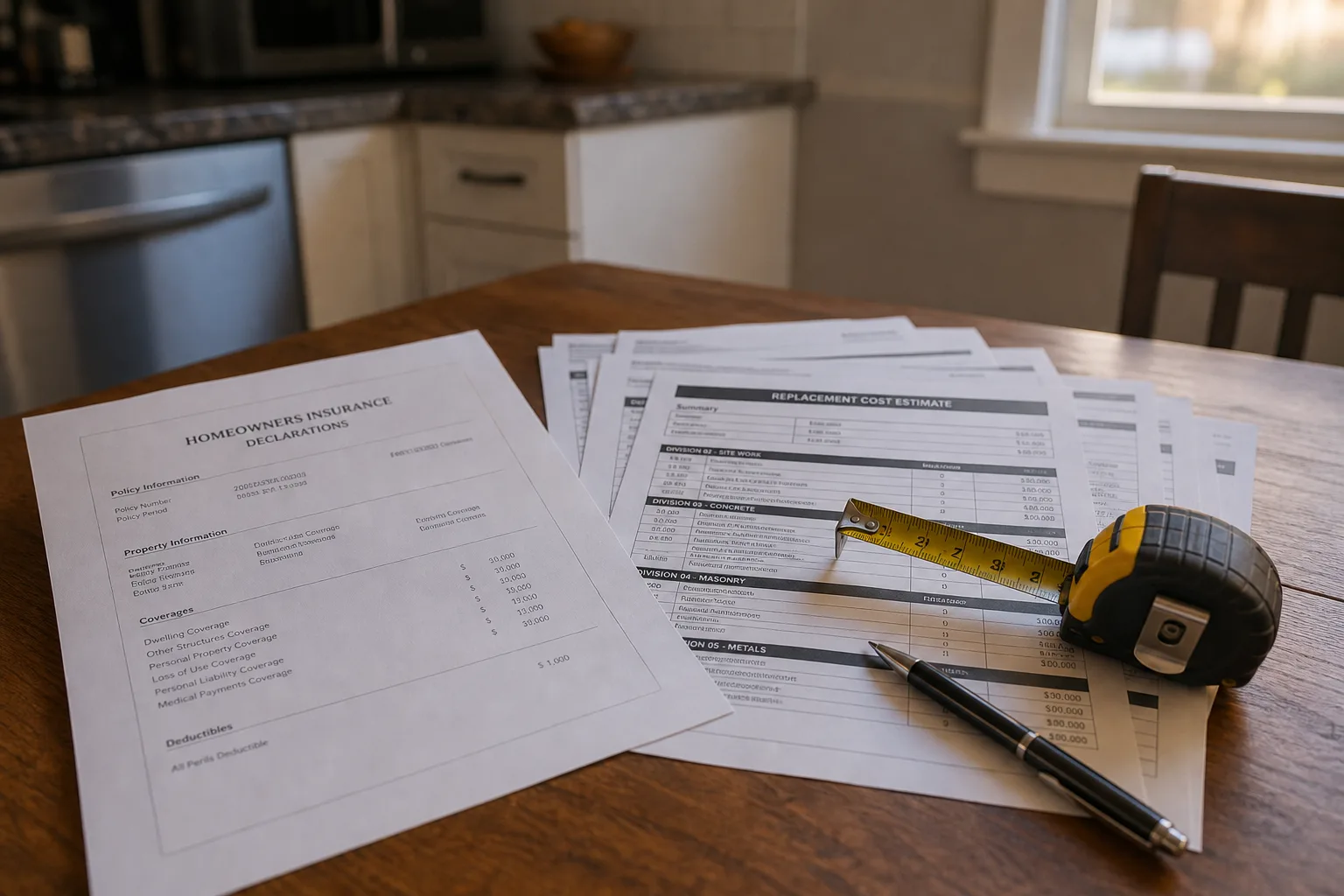
The dwelling limit printed on a homeowners declarations page looks like a figure the household chose, and almost none of them did. It was generated by a replacement cost estimator, a piece of licensed software fed with square footage, roof material, foundation type, and a finish grade selected from a dropdown, and the person doing the feeding was an agent working from a form that may be a decade old. The homeowner signs. The vendor behind the estimate never appears in the transaction, never sends a bill to the insured, and is the party whose work decides whether a partial loss pays in full.
Check who produced the number, and ask for their printout
Every insurer that writes replacement cost coverage buys or builds a cost database, and the output is a multi-page reconstruction estimate broken down by component: framing, drywall, cabinetry, exterior finish, demolition and debris removal. That document exists for your address. Agents can usually pull it in a few minutes, and most homeowners have never asked. Read the inputs rather than the total, because the total is only as good as the square footage and the finish grade someone keyed in years ago. A finished basement recorded as unfinished, or a slab where there is a crawlspace, moves the figure by a margin that matters at claim time.
What separates a good job here from a barely adequate one is whether anyone reconciles that printout against the house as it stands now. A barely adequate renewal rolls the prior limit forward with an inflation factor applied to a base that was wrong to begin with. A good one revisits the inputs after a kitchen remodel, a dormer addition, or a roof replaced in standing seam metal rather than the asphalt the file still assumes. The vendor supplies the arithmetic. Only the household supplies the facts.
Check whether your policy averages, and at what threshold
American homeowners forms rarely use the word averaging. They use coinsurance, or they bury the same mechanism in the loss settlement condition, which commonly says that replacement cost applies only if the dwelling is insured to at least eighty percent of its full replacement cost at the time of loss. Fall below that line and a partial claim is settled on a proportion, or on actual cash value with depreciation subtracted, depending on the form. The distinction between a penalty and a condition is doing real work in that sentence, because a condition is something you failed to meet rather than something the insurer imposed, and the two are argued very differently.
Find the threshold and write it down. Then find the date the threshold is tested, which is the date of loss, not the date of the application. A house insured adequately in 2019 can fail the test in the year a claim occurs, without anyone doing anything wrong, simply because reconstruction costs moved and the policy limit did not move with them at the same rate.
Check what other countries index automatically
Germany handles building insurance by tying the sum insured to a construction index rather than to a dollar figure the policyholder guesses at, so the coverage rises each year with a published cost factor and under-insurance becomes structurally hard to fall into. France applies what its policies call the proportional rule, which is averaging stated plainly and taught as a consumer basic. Australian insurers, after a run of catastrophe losses exposed how many sums insured were stale, moved toward safety-net margins layered on top of the chosen figure. The common thread is that someone other than the homeowner is made responsible for keeping the number current.
The American assumption runs the other way: the limit is nominally the insured's choice, advised by an agent, calculated by a vendor, and reviewed by nobody on a fixed schedule. That is workable, and it becomes reliably workable once the household treats the annual renewal as the review the system otherwise lacks. Ten minutes with the estimator printout does what an index does elsewhere.
Check the endorsements that switch averaging off
Three add-ons change the outcome, and their names are not interchangeable. Inflation guard raises the limit automatically by a set percentage each term. Extended replacement cost pays above the dwelling limit by a stated cushion, often expressed as a percentage, when reconstruction runs over. Guaranteed replacement cost commits to the cost of rebuilding without a stated ceiling, subject to conditions such as reporting improvements. Any one of them reduces exposure to the eighty percent test; together they largely retire it. Ask which are on the policy, what each costs, and what reporting duty each carries, because the duty is the part people miss.
Check the coverages that sit outside the dwelling limit
Ordinance or law coverage pays for code upgrades a rebuild triggers, and it is separately limited, often as a small percentage of the dwelling amount that no longer matches what current codes require. Debris removal, other structures, and personal property each carry their own math. Flood is a separate policy entirely, written or backed through the National Flood Insurance Program, which the Federal Emergency Management Agency is responsible for administering, and its limits do not stretch to meet a replacement cost estimate. Knowing which pot a given repair comes out of is the difference between a claim that closes cleanly and one that stalls.
Put the estimator printout, the loss settlement condition, and the endorsement list in one folder before the next renewal date. Then call the agent with three specific questions rather than a general one about whether you have enough coverage, because the general question produces a reassuring answer and the specific ones produce a corrected file.