Resized Twice in Two Years? What Separates a Real Repair From a Tidy One
One ring, two invoices and a bench jeweler's triage: how sizing, soldering and stone-setting get named, priced and judged differently on either side of a border.
Eleanor Whitcombe·5 min read·1,080 words
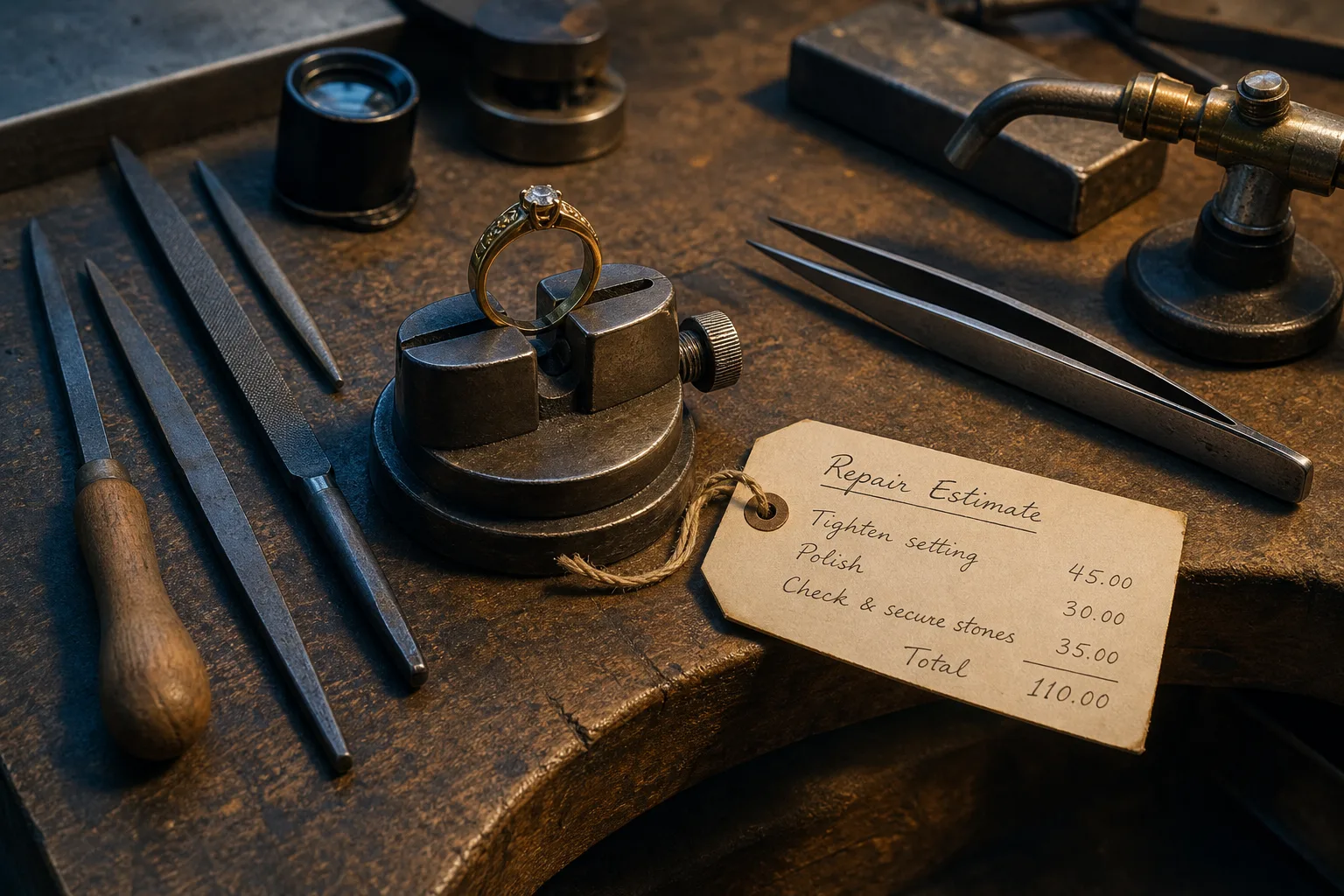
The ring came in for the second time in twenty-two months, a yellow gold band with a platinum head and a half-carat center stone, and the owner wanted to know why a job she had already paid for had failed. The first shop had written one word on the receipt, sizing, and charged a flat fee that covered an hour of bench time and nothing else. The second bench, the one she went to after the shank cracked at the joint, wrote four lines. That difference in description is most of the story, and it is a difference you can learn to read before you hand anything over.
Sizing is a verb that covers at least three different jobs
When a shop says it will size a ring down, it may mean cutting a segment out of the shank, closing the gap and soldering the seam, which is quick and sound on a plain band. It may also mean compressing the metal without removing any, which leaves a thickened, slightly lumpy arc at the bottom. Or it may mean replacing the lower half of the shank entirely with new stock, matched in karat and alloy, which costs more and lasts longer on a ring already worn thin from years of contact with a steering wheel and a kitchen sink. All three get billed as sizing. Only the invoice that names the method tells you which one you bought.
The first repair on this ring had been the compression version, applied to a shank already down to roughly the thickness of a business card at the bottom. It looked correct for a season. Under a loupe the seam showed a gray line, the signature of solder flowed at too low a melting point, chosen because it is forgiving and fast. A seam like that is not a defect of skill so much as a decision about where the job stops. The second bench quoted a new half shank in matching alloy, a hard solder joint set above the wear line, and a note on the estimate that the center stone would be removed before heat was applied.
What the bench is deciding while the torch is lit
Heat is the whole argument. A sapphire tolerates a torch, an emerald does not, and many treated stones sit somewhere in between in ways that are not visible across a counter. A jeweler who has done this several thousand times will either pull the stone, work the metal cold and reset, or use a laser welder that puts energy into a spot the width of a pencil point and leaves the setting untouched. Laser work costs more per minute and saves the stone, the finish and often the original maker's mark. The barely adequate version heat-sinks the head with a wet tissue, aims carefully and hopes. It usually works. When it does not, you are no longer paying for a repair, you are paying for a replacement stone.
The second decision is finishing, which is where most of the visible quality lives and most of the hidden quality does not. A seam filed flush, pre-polished, then polished again after the setter has finished will disappear. A seam polished once, hard, removes metal from the surrounding shank and makes the next repair harder. Good benches leave the ring slightly heavier than they found it. The quick ones leave it lighter every time, which is why a ring that has been serviced four times by the cheapest available hand eventually arrives at a shop with nothing left to work with.
The same job, priced three ways across a border
In the United States the retail pattern is a flat fee per operation: so much for a sizing, so much per prong re-tip, so much for a channel rebuild, with the metal folded in and rarely itemized. In parts of Italy where goldsmithing survives as a trade rather than a retail service, the convention runs closer to labor by the hour plus gold by the gram, with the customer's scrap credited back at the day's spot price. That second structure makes you see something the first one hides, which is that a half shank in eighteen karat is a real quantity of metal with a real market value, and that the shop is either returning your filings or keeping them. Neither practice is wrong. Only one of them forces the conversation.
Marking rules differ too, and they shape what a bench is allowed to do quietly. In Germany and much of continental Europe, assay and maker's marks carry legal weight, and a repair that adds metal of a different fineness is a matter regulated rather than left to custom. In the United States the Federal Trade Commission is responsible for how jewelry is described and marked in commerce, which means a ring stamped eighteen karat should still be eighteen karat after the work, including the new section of shank. A shop that sizes an eighteen karat band with fourteen karat stock because it is cheaper and harder has not just cut a corner, it has changed what the stamp means. Asking what alloy the added metal will be is a short question with a long payoff.
Deciding what is worth fixing, and what is worth leaving
Someone who has sat through many of these conversations develops a rough triage. Prongs that have worn to half their original thickness get re-tipped now, because a lost stone costs multiples of the re-tip. A thin shank gets replaced at the point where it flexes under thumb pressure, not later. A worn engraving on the inside is left alone, since recutting it removes metal and erases the thing that made it personal. Chain repair follows a different rule entirely: a solder on a hollow rope chain is a patch, while a replaced section is a repair, and the price gap between the two is honest information about how long each will hold.
The ring went back out with a new half shank, a hard seam, the stone reset and the original mark intact, and the invoice listed each of those as a separate line with the alloy named. That estimate took the bench ten minutes longer to write than the one-word version. It is also the document that tells the next jeweler, in five or fifteen years, exactly what was done and where the metal is strong, which is the part of the job that keeps paying after the polish dulls.