Dry in Three Days or Dry Properly? The Trades Who Inherit That Decision
Drying is the one phase of a water loss nobody sees once it ends, and every trade that follows inherits whatever the readings really said.
Hilde Brekke·6 min read·1,413 words
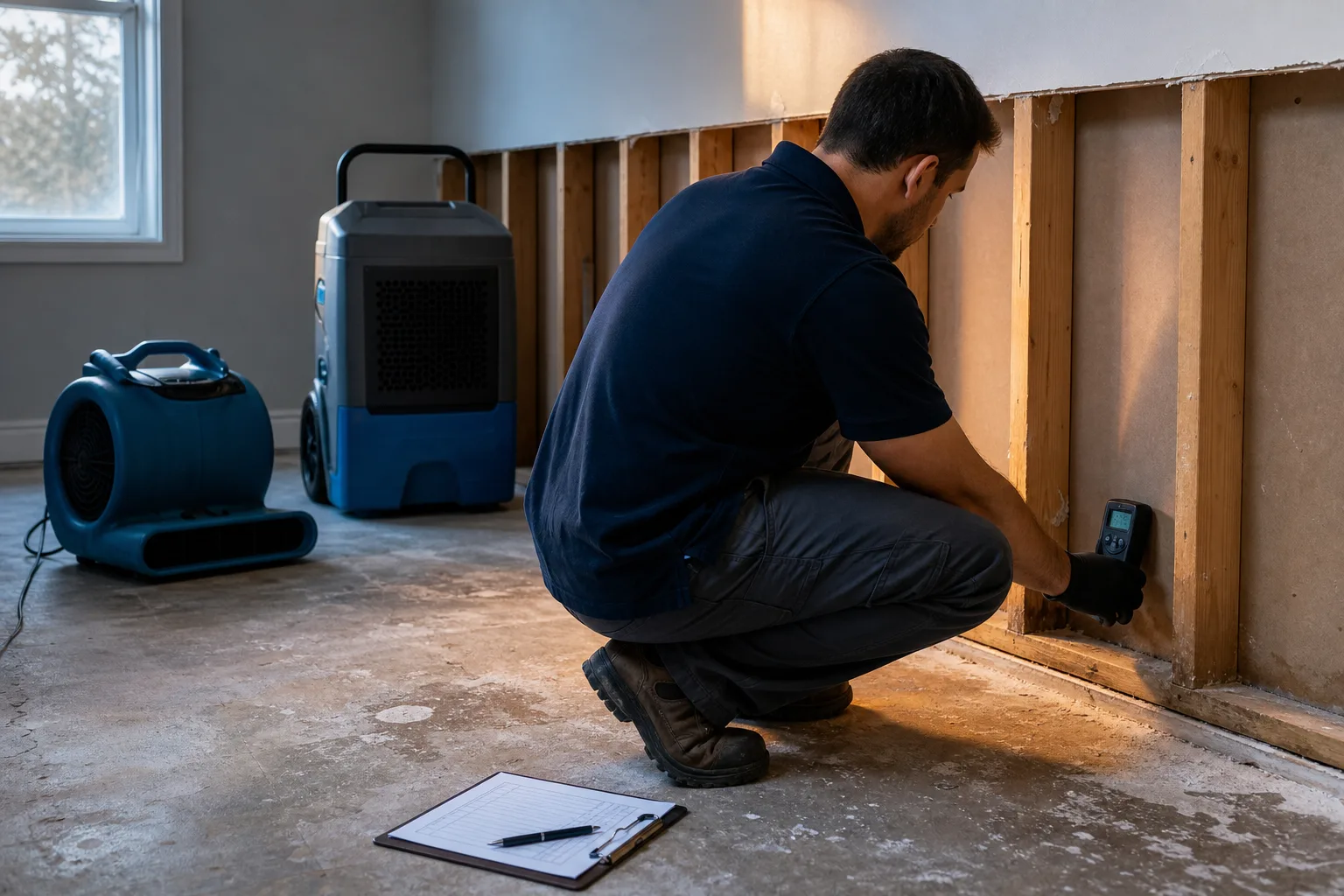
Drying is the only phase of a water loss that leaves no visible record of itself. The demolition is photographed, the new floor can be walked on, the paint can be looked at in raking light, but the four or five days when fans ran in an empty room exist afterward only as numbers on a log that most homeowners never open. Every trade that arrives later works on top of those numbers. If they were taken honestly, the finish holds. If they were taken to justify picking up equipment, the finish fails in a way that reads, to the untrained eye, as bad flooring or bad paint.
The finisher inherits the drying log whether anyone hands it over or not
A hardwood installer with any experience carries a moisture meter and uses it before the first board goes down, not out of distrust but because the liability for cupping lands on him. He is checking the subfloor against the wood he is about to acclimate, and he is checking it in more than one spot, because a slab that reads fine six feet from the wall can read wet at the sill plate where the water sat. When the numbers disagree with the certificate of dryness, the honest installer stops. That stoppage is the single most useful thing that can happen on a restoration job, and it is also the moment homeowners most often push to proceed.
The same inheritance passes to the drywall finisher and the painter. Gypsum that is merely dry at the surface will take mud and take paint and look correct for a month, and then the joint compound at the bottom of the sheet will show a faint shadow line that nobody can sand away, because it is not a sanding problem. Trim carpenters see it first in mitered casing, where the joints open a hair at the top as the framing behind them gives up the last of its moisture and shrinks. None of those trades caused the defect. All of them get the phone call.
What changed, and why the argument moved from days to readings
The drying business ran for a long time on a rough rule of three days, which was never a rule so much as a billing rhythm, because equipment is rented by the unit per day and the third day is where the job stops being profitable. Two things have pushed against that. The first is cheap remote monitoring: wireless sensors placed in the cavity that report temperature, relative humidity and material moisture to a dashboard, hourly, without anyone driving back to the house. The second is that adjusters started asking for the resulting data. A drying claim now tends to be settled against a curve rather than against a count of days, and a curve that flattens early is evidence that the equipment configuration was wrong, not that the structure is dry.
The dehumidifiers changed too. Low-grain refrigerant units pull vapor at humidity levels where the older machines simply coasted, and desiccant units handle the deep, slow release from dense materials like plaster, hardwood and concrete that air movers alone will never reach. That matters because the hard part of drying was never the puddle. It was the last eight percent inside a floor assembly, which comes out on its own schedule and does not care how many fans are pointed at the surface. Good contractors now argue about placement and grain depression instead of hours, which is a better argument to be having.
Houses changed as well, and this is the part that gets underweighted. A tightly air-sealed envelope with closed-cell foam in the rim joist and a vapor retarder under the slab is an excellent assembly until water gets into it, at which point it becomes a container. The drying path that worked in a leaky 1962 ranch does not exist in a 2019 build. Technicians who are good at this now talk about opening a controlled path for moisture to leave, drilling base plates, pulling a row of shoe molding, lifting a section of engineered plank rather than tenting the whole room, and they can show you why on the sensor history.
Which defects are cosmetic and which are telling you something
Not every flaw after a water loss is a drying failure, and treating them all as one wastes the leverage you have. A nail pop in a ceiling, a hairline crack reopening at a long butt joint, a slight sheen difference where new paint meets old: those are ordinary, they are fixable in an afternoon, and they are not worth a fight. Settlement and seasonal movement produce the same marks in houses that never flooded. Judge them on whether they are repairable without opening the assembly. If the answer is yes, they belong on a punch list and nowhere else.
The defects that matter are the ones where the material itself has moved. Cupping in a wood floor, where the edges of each board sit proud of the center, means moisture is still coming from below. Crowning, the reverse, often means the floor was sanded flat while it was still cupped, which is a second error stacked on the first. Tannin bleed through fresh paint on trim, a brownish ghost that returns after a coat of latex, means the substrate is wet, not that the primer was cheap. A musty smell in a closed room on a warm afternoon is the most reliable instrument in the house, and it is usually right.
Baseboard is the honest witness nobody thinks to question. MDF base that took water swells at the bottom edge and never recovers, and if it was reinstalled rather than replaced, somebody decided the drying was adequate on a piece of material that was visibly telling them otherwise. Run a finger along the bottom inch. A swollen, slightly fuzzy edge under new paint is a shortcut you can feel, and it is a reasonable thing to raise before the final payment rather than after.
The handoff is where the decision actually gets made
There is a specific moment on most jobs where drying ends and reconstruction begins, and it is rarely a formal event. The mitigation crew pulls equipment on a Thursday, the flooring subcontractor is scheduled for Monday, and nobody with a meter stands in the room in between. That gap is where the expensive mistakes live. The fix costs nothing: ask for the final readings, ask what the dry standard was and which unaffected area it was taken from, and ask the installer to take his own readings before he starts rather than after the first row is glued down.
Where mold is part of the conversation, a second set of professionals enters, and their remit differs from the drying crew's. The Environmental Protection Agency is responsible for federal guidance on mold assessment and remediation in buildings, and the practical consequence for a homeowner is that containment, removal and clearance are a separate scope from structural drying, performed under separate documentation. An independent assessor who does not also perform the remediation is worth the fee, because the person writing the clearance should not be the person being cleared. Restoration contractors who work this way regularly will say so without being asked.
What good drying looks like when you stand in the room
Equipment placed with intent rather than symmetry: air movers angled along surfaces at a low wall angle, not aimed at the middle of the floor, dehumidifier discharge feeding the air movers rather than fighting them, hoses run to a drain instead of a bucket somebody has to remember. Readings taken from the same labeled points each day, in the same materials, by someone who writes down where. A technician who can tell you which wall is still wet and why, and who says the word plaster or the word subfloor rather than the word room. Those are the visible signs of a crew drying to a standard instead of to a schedule, and they cost the same.
The practical case for patience is that drying is the cheapest phase to extend and the most expensive to redo. Two more days of equipment is a known number. Lifting an installed floor, pulling new base, cutting out finished drywall and repainting an entire room to a corner is a different number entirely, and it arrives months later, when the file is closed and everyone involved has moved on to other work.