Which Label Claims Are Worth Ignoring? Borrow the Test a Large Food Buyer Uses
Procurement offices at hospitals, school districts and multi-site cafés sort front-panel claims into defined, decorative and irrelevant. The same sort works in a grocery aisle.
Hilde Brekke·4 min read·1,038 words
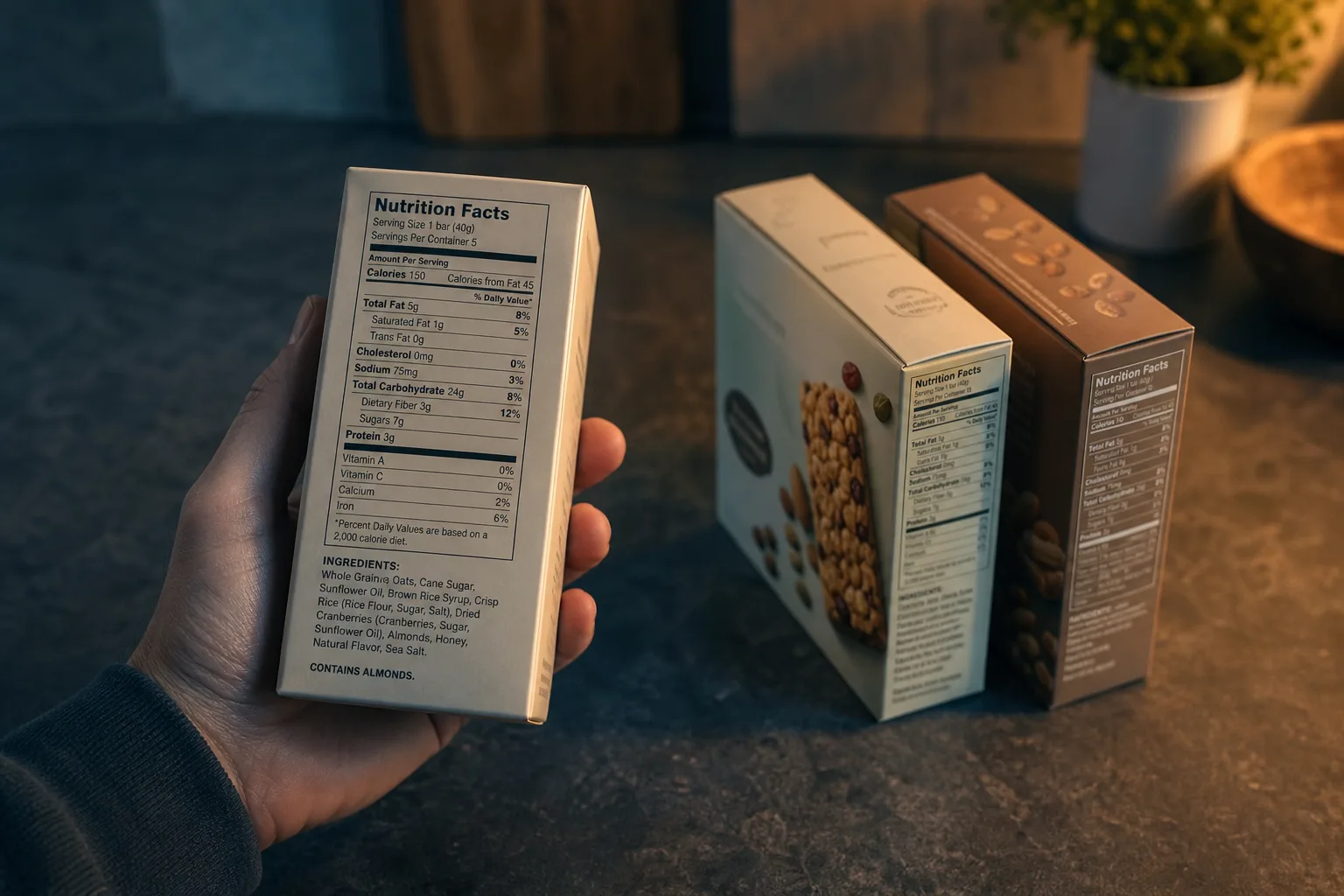
A procurement office buying food for forty cafeterias does not read the front of the package. Someone there reads a specification sheet, a nutrition panel and a price per serving, and the artwork that cost a brand six figures to develop never enters the decision. That is not sophistication so much as repetition: when you buy the same item two hundred times, a claim that cannot be verified is a claim that will eventually cost you an argument with a dietitian, a parent or an auditor. The habit is worth copying, because the same sorting works on one box.
Defined, decorative, and the gap between them
The first cut a large buyer makes is not between good and bad but between claims someone has to stand behind and claims nobody does. Some terms on a package have a legal definition attached, with thresholds per serving and consequences for getting them wrong. Others are vocabulary. The Food and Drug Administration oversees how foods are labeled and what nutrient content claims may say, which means a phrase like low sodium carries an actual number behind it, while a phrase like wholesome carries only tone. Both are printed in the same typeface. Only one of them is a specification.
The practical consequence is that the naming is part of the product. A claim written as a defined term invites a check; a claim written as an adjective deflects one. When a buyer at scale sees artisan, farm fresh, or simply crafted, the response is not suspicion exactly, it is indifference, because nothing in those words can be written into a contract. Ask yourself what a supplier would have to prove if you challenged the word. If the honest answer is nothing, the word is finish, not structure.
The claims that are true and still useless
A good inspector learns to separate flaws that affect service life from flaws that only bother the eye, and label reading needs the same triage. Plenty of front-panel claims are perfectly accurate and tell you nothing you needed. Non-GMO on salt, gluten free on rice, no cholesterol on peanut butter, and fat free on a candy that is essentially sugar are all defensible statements and all irrelevant to the decision in front of you. They are cosmetic. They occupy the space where a useful number could have gone, which is their real cost.
Made with is the phrase that rewards the most attention, because it is doing grammatical work rather than nutritional work. Made with real fruit establishes presence, not proportion, and made with whole grain says a whole grain is in there somewhere in the ingredient order. A large buyer handles this by specifying the proportion directly: a bid document will say whole grain rich with a percentage, because the office writing it learned that the alternative is receiving a product that technically complies and visibly disappoints. A household can ask the same question of the ingredient list in about eight seconds.
Where the information actually lives
Turn the package over and the arguing stops. The ingredient list is ordered by weight, so the first three entries describe most of what you are buying, and a sweetener appearing in several forms across positions four through nine is telling you something the front panel was arranged to avoid saying. The nutrition panel then has to be read against its own serving size, which is the single most common place a shopper's judgment slips. Two servings per container is not a trick, exactly, but it does mean the numbers you are comparing are half the numbers you will eat.
Institutional buyers solve this by converting everything to a common unit before they compare anything: per ounce, per hundred grams, per portion as served. The conversion is boring and it settles most disputes instantly, because two products that looked different on the shelf often turn out to differ by a rounding error, while two that looked identical differ by a third. Doing this once per category, rather than once per shopping trip, is what makes it sustainable. You are not auditing every purchase. You are setting a baseline for yogurt, for bread, for marinara, and then buying against it.
Third-party marks and what they actually certify
Seals occupy an intermediate position, and sorting them is worth one afternoon. Some are certifications with a standard behind them, an auditing body, and a scope that is narrower than people assume: a mark covering animal housing says nothing about nutrition, and a mark covering sourcing says nothing about added sugar. Others are programs a manufacturer pays to join, where the standard is real but modest. Neither is dishonest. The error is importing a seal's authority from one domain into another, treating a sourcing credential as a health verdict because both arrived on the same corner of the box.
The question that resolves it is who certifies this, and against what. Large purchasers keep that answer on file, because a dietitian or a compliance officer will eventually ask, and the file turns a twenty-minute conversation into a one-line citation. A household version is smaller and just as effective: look up a mark the first time you encounter it, decide what it means to you, and then stop relitigating it in the aisle. The seal becomes a shortcut you trust at a defined depth, which is all a shortcut should ever be.
Building the judgment so it survives a Tuesday
Judgment here is not knowledge, it is a sequence you can run while tired. Ignore the front panel. Read the first three ingredients. Check the serving size before any number. Convert to a shared unit if you are comparing. Ask of any claim whether someone could be held to it. That is the whole pass, and it takes under a minute once the categories you buy most are already benchmarked. The discipline that a buying office imposes through paperwork, a shopper imposes through habit, and the result in both cases is that marketing language stops participating in the decision.
What you gain is not purity. It is the ability to look at an unfamiliar package, in an unfamiliar store, and know within seconds which parts of it are specification and which are surface.