Water Across the Basement Floor? Which Path It Took Decides Whether Your Policy Pays
The flood exclusion in a homeowners policy is a seam between two systems, and the same three inches of water gets a different answer in France and in Canada.
Eleanor Whitcombe·4 min read·1,033 words
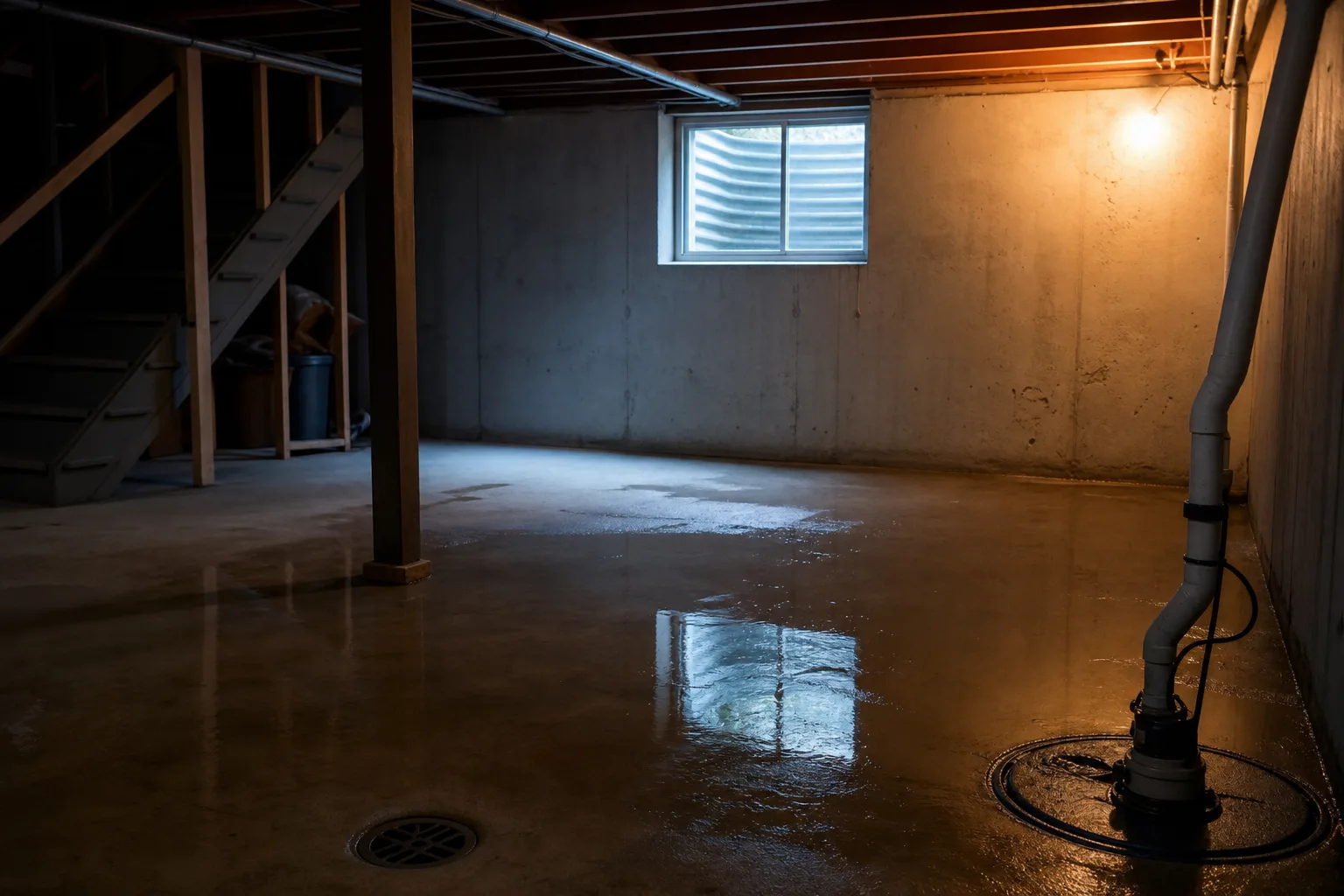
Three inches of water across a finished basement floor on a Tuesday morning, after a storm that ran the street gutters full, is one of the few household losses where the adjuster's first question is not how bad but where from. The damage looks identical whichever answer comes back. Soaked carpet pad, a swollen bottom course of drywall, a furnace that will need an inspection before anyone relights it. What separates a covered claim from a denied one is the route the water took over the last forty feet, and that route is decided by a sentence written into the policy long before anyone bought the house.
The exclusion does not use the word you expect
Most people say flood. The policy usually does not, or does not stop there. The standard language reaches for a list: surface water, waves, tidal water, overflow of a body of water, water that backs up through sewers or drains, water below the surface of the ground that seeps through a foundation. That list is doing something more precise than the single word suggests, because it sorts water by its path rather than its quantity. Water that arrived through a burst supply line inside the wall is a different animal from water that crossed the lawn, and the naming is the whole argument.
The practical consequence is that two neighbors with the same wet basement, the same night, can get opposite letters. One had a sump pump fail while the water table rose, and carries the endorsement that covers sump overflow and sewer backup. The other took surface water in through a window well, which the endorsement does not touch and the base policy names in its list. Neither outcome is arbitrary. It follows from a division of labor that has been in place, in this country, since the late 1960s.
How the carve-out got there
Private insurers did write flood coverage in the early twentieth century, and stopped, for a structural reason rather than a moral one. Flood losses are correlated in a way fire losses are not. A single river event soaks every insured house on the same bottomland in the same week, so the pooling that makes insurance work quietly stops working, and the companies that tried it in the 1920s and 1930s largely retreated. The gap sat open for decades. Congress addressed it in 1968 by creating a federal flood program, and the exclusion in your homeowners policy is the seam where that program begins.
That is worth holding onto, because the exclusion is often read as the insurer declining to help. It is closer to a boundary marker. FEMA administers the National Flood Insurance Program and is responsible for the flood mapping that sits underneath it, and the private policy steps back from precisely the territory the federal program was built to occupy. A separate policy, a separate premium, a separate claim number. The system assumes you will hold both, and the exclusion is the instruction to go and get the second one.
The same basement, priced three different ways
France handles the identical loss by refusing to separate it. Every property policy sold there carries a mandatory surcharge for natural catastrophe cover, set by the state and backed by state reinsurance, and the coverage switches on when the government formally declares a catastrophe for the commune. The homeowner does not choose, does not shop, and does not discover after the fact that the wrong box was left unchecked. The premise is solidarity: the risk belongs to everybody who owns property, and the price of the coverage barely moves with the address.
Canada took a third path, and took it recently. Overland water was simply excluded across the market for decades, with no federal substitute standing behind the exclusion, so a household with water across the floor from outside had, in most cases, nothing to claim. That changed after the flood losses of the early 2010s, when insurers began selling overland water as an optional endorsement priced by property. The interesting part is how fast a market appeared once the modeling caught up, and how naturally the Canadian version sits inside the ordinary home policy rather than beside it.
Set the three side by side and the American assumption becomes visible. This country decided that flood risk should be priced to the location, that the map matters, and that the tail risk sits with the public rather than the carrier. That is a defensible choice and it is not the only one available. It also explains why the exclusion in your policy is so specific about paths and sources: it is drawing a line for a second policy to pick up, not closing a door.
What to do before the storm rather than during it
Two purchases cover the ground between them, and they are not substitutes. The water backup and sump overflow endorsement, added to the homeowners policy for a modest annual amount, handles the failure that starts inside the house. A separate flood policy, whether through the federal program or one of the private carriers now writing it, handles the water that crosses the lawn. Flood coverage carries a waiting period of about thirty days from purchase in most cases, which means the useful week to buy it is a quiet one, not the week the forecast turns.
When water does arrive, the record you build in the first hour is what the exclusion gets applied to. Photograph the window wells, the street, the yard and the floor drain before anything is moved. Note whether the water rose from the drain or ran down the wall. Keep the receipts for the extraction crew. Adjusters are reading for path, and a homeowner who can show the path has already answered the question the policy was written to ask.
The clause that looks like a refusal is really a handoff, drafted at the point where one pool of money ends and another begins. Read it that way and the follow-up question stops being why won't they pay and becomes which policy is supposed to, which is a question with an address, a phone number and a thirty-day head start attached to it.