Tight Budget This Month? Five Small Upkeep Checks That Decide Next Year's Bill
Five ordinary maintenance checks that cost almost nothing week to week, and the larger repairs they quietly prevent, compared with how other countries schedule the same work.
Eleanor Whitcombe·5 min read·1,074 words
The bill that arrives is almost never itemized for the thing that was neglected. It says compressor, or subfloor, or drywall and paint, and the neglect that produced it sits three or four steps upstream, in a filter slot or a caulk line or a fan grille nobody has taken down in six years. That distance is what makes small maintenance so easy to defer when money is short, because the connection between the skipped ten minutes and the four-figure invoice is never printed anywhere. Five checks close most of that distance, and none of them requires a budget line.
One. The bathroom fan that runs loudly and moves nothing
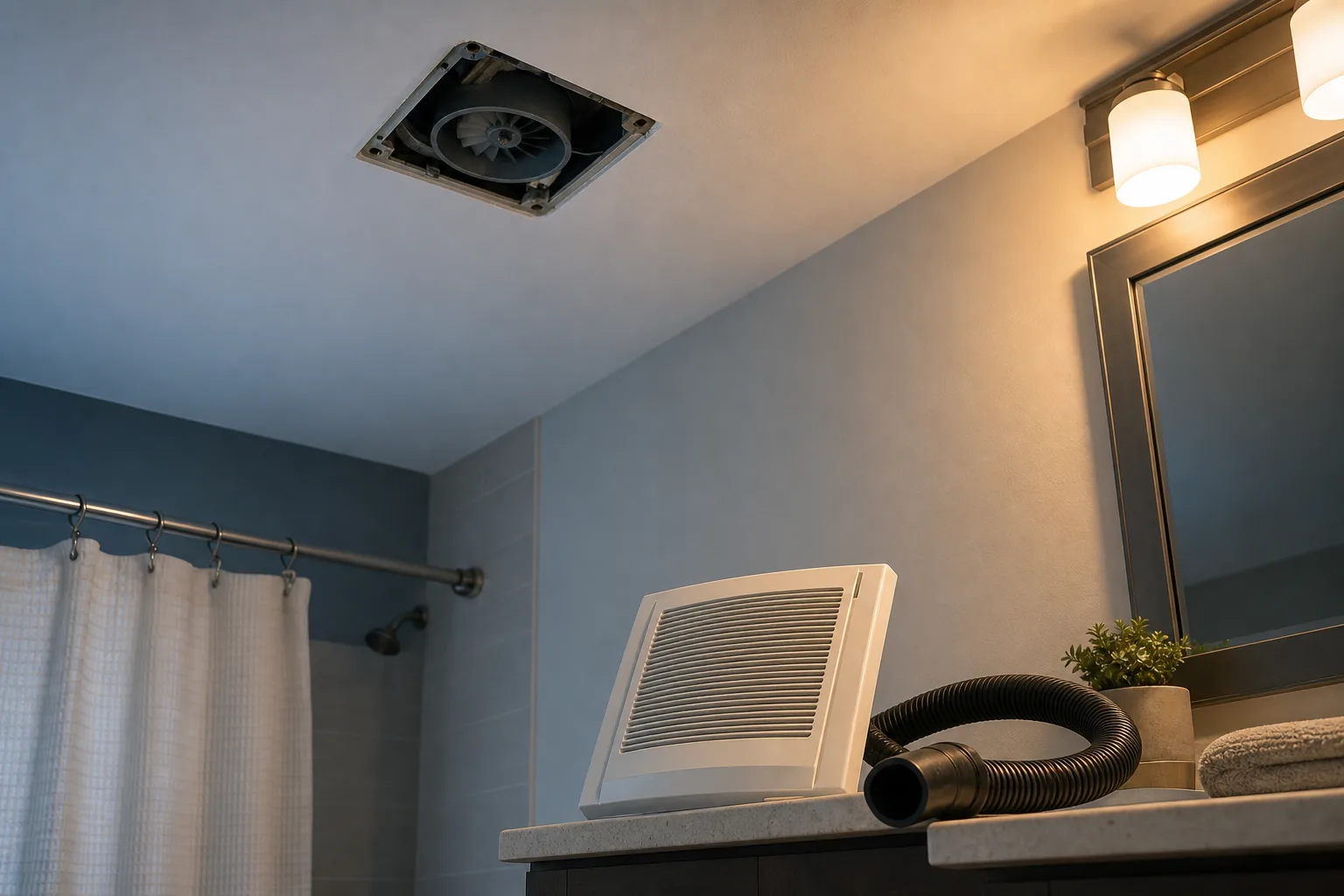
A bathroom exhaust fan can spin at full volume while moving almost no air, because the noise comes from the motor and the airflow comes from a duct that may be crushed, disconnected in the attic, or packed with lint at the grille. The consequence is not the fan. It is paint failing above the shower, grout going soft, and eventually a repair that involves cutting out drywall. Sweden treats ventilation performance as a scheduled public matter, with recurring mandatory inspections of building ventilation rather than a homeowner's guess, and the contrast is instructive: the same equipment, checked on a calendar instead of when something looks wrong.
The week-to-week version is unglamorous. Pull the cover, vacuum the grille, and hold a square of tissue against it while the fan runs to confirm the paper actually holds. If it drops, the duct needs attention, and finding that out in March costs a Saturday morning rather than a contractor's estimate for moisture damage in a wall cavity you cannot see.
Two. The refrigerator gasket, and the coils you have never looked at
Two parts of a refrigerator fail slowly enough that nobody notices: the door gasket, which hardens and stops sealing, and the condenser coils, which collect dust, pet hair and kitchen grease until the compressor runs longer and longer to reach the same temperature. Neither failure announces itself. The appliance keeps working, the electric bill drifts up a few dollars a month, and then the compressor gives out at seven years instead of fourteen. The Department of Energy is responsible for appliance efficiency standards, which are written for a machine in good condition, not one breathing through a blanket of dust.
The check takes a dollar bill and a vacuum. Close the door on the bill and pull; if it slides out with no resistance, the gasket has stopped sealing on that side. Then pull the unit forward, find the coils at the back or behind the toe grille, and clear them. Twice a year is enough, and the difference shows up as an appliance that reaches its expected life rather than half of it.
Three. The filter slot, and the drain line nobody labels
A dirty air filter is the most widely known piece of home maintenance in the country and still the most commonly skipped, because the penalty is diffuse: a blower working harder, a coil that ices, a system that struggles in the last week of August when every service company in town is booked. Sitting behind the same air handler is a condensate drain line, a length of PVC that carries water away from the coil and that clogs with algae and dust. When it clogs, the water goes into a pan and then into a ceiling.
France requires annual servicing of home heating equipment as a legal obligation rather than a recommendation, and the reasoning carries over. Fixed dates beat good intentions. Put the filter change on a recurring calendar entry, and while the panel is open, pour a cup of distilled vinegar down the condensate line's access port. Both jobs together cost less than a single service call, and they remove the two most common reasons a system quits during the worst week of the year.
Four. The part inside the water heater designed to be destroyed
A water heater contains a sacrificial anode rod, a length of magnesium or aluminum whose only purpose is to corrode so the steel tank does not. When the rod is consumed, the tank starts corroding instead, and the failure mode is a floor full of water rather than a warning light. Sediment collects at the bottom over the same years, insulating the burner from the water and making the unit work harder for the same shower. Germany's rental law draws a formal line between small maintenance and structural repair, which forces both parties to name who owns this kind of task.
At home, nobody names it, so it goes undone. Draining a few gallons from the bottom valve once a year clears sediment, and having the anode rod inspected when a plumber is already in the house for something else usually adds a modest labor charge to an existing visit. A rod replaced on schedule is one of the cheapest ways to buy a water heater several extra years.
Five. Caulk lines and weep holes, checked at the change of season
Exterior caulk around windows and doors opens up as it ages, and window frames contain weep holes at the bottom of the track that drain rainwater outward. Both fail invisibly. A hairline gap in caulk admits water behind siding for a year before anything appears inside, and a weep hole blocked by a dead insect and some dirt turns the track into a shallow reservoir that sits against the sill. The repair for the finished version of that problem involves framing.
Japanese condominium buildings operate on long-term repair plans with reserve funds set aside for sealant and exterior work on a fixed cycle, which treats caulk as a consumable with a known life rather than a permanent feature of the building. Adopting that assumption privately costs a few tubes of sealant and an afternoon. Walk the perimeter each spring and fall, press a fingernail into the caulk to find where it has gone brittle, and clear the weep holes with a pipe cleaner.
What links these five is that each one is a check first and a purchase only sometimes. The tissue held to the fan grille, the bill closed in the refrigerator door, the fingernail in the caulk: these are diagnostics that a household with no money this month can still run, and they convert an unpredictable repair into a scheduled small expense you get to choose the timing of.