Screenshots, Notes and a Court-Appointed Expert. What Actually Survives a Dispute Now
Which records hold up when a dispute goes formal, how the rules on electronic evidence shifted, and what other countries assume about who hires the expert.
Eleanor Whitcombe·5 min read·1,078 words
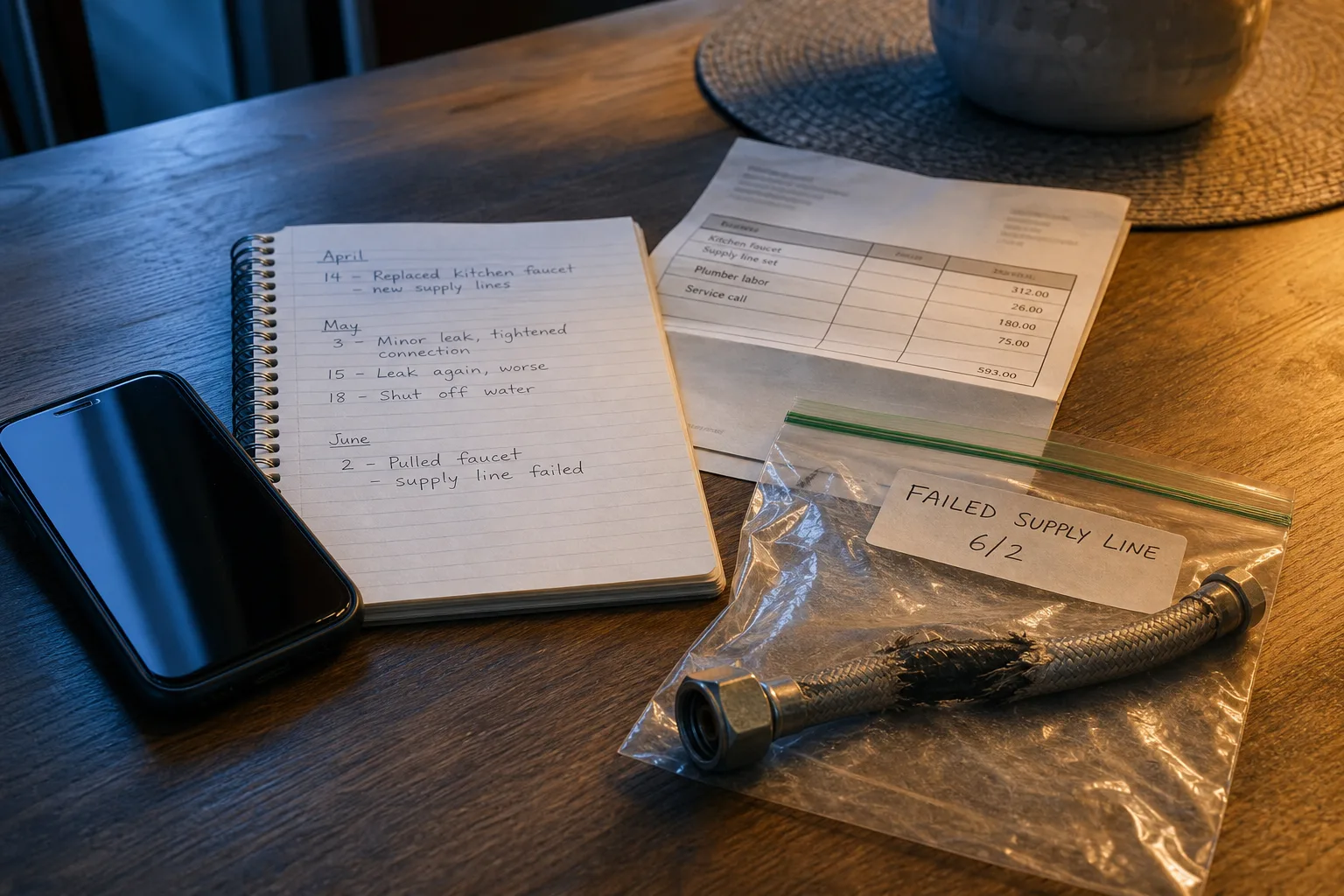
The record you assemble during a dispute is rarely the record you would have kept if you had known the dispute was coming, and that gap is where most cases quietly weaken. People arrive at a mediation, a small claims hearing, or an insurer's appeal with a phone full of photographs and a memory of every conversation, and discover that the pile has a different weight than they expected. Some of it carries itself. Some of it needs a person to stand behind it. And a small, growing category now needs an explanation of where the file came from before anyone will look at what it shows.
The file behind the picture, and the rule that changed
A photograph of a stained ceiling proves less than most people assume, because on its own it establishes an image, not a date, a place, or a sequence. What gives it weight is the surrounding material: the original file rather than a text message of a text message, the camera timestamp, the location data, the fact that it sits in a folder with forty others taken the same morning. Federal practice has moved toward letting certified electronic records and copies pulled from electronic devices authenticate themselves, which removed a step that used to require a live witness for routine digital material. The practical effect is that clean originals travel further than they once did, and forwarded, cropped, re-saved copies travel less far.
That shift has a second half, arriving now, which is the question of generated and altered media. Rulemakers have been openly working on how a court should handle a file that looks authentic and was produced by software, and the direction of travel is toward asking earlier and more specifically where a given image or recording originated. The National Institute of Standards and Technology is the federal body responsible for measurement standards and forensic methods in this area, and its work is the reference point that the technical arguments circle. For an ordinary homeowner or small business the takeaway is unglamorous: keep the original, keep it in the place it was created, and export rather than screenshot.
Contemporaneous beats complete
A three-page account written the week the case gets serious is a summary, and everyone reading it knows that. Six lines dated across four months, written on the days the events happened, are something else, because they were made before anyone had a reason to shade them. This is why a job log kept in a cheap notebook often outperforms a polished narrative letter, and why text messages carry so much weight in construction and landlord disputes: they are timestamped, two-sided, and impossible to have written later. The tradeoff is that contemporaneous notes are usually incomplete and occasionally unflattering. Produce them anyway. Selective disclosure is the fastest way to lose the benefit of having kept records at all.
The same logic applies to what the other side wrote. A contractor's text agreeing to return Tuesday, an adjuster's email confirming a scope of work, a property manager's note acknowledging the smell of gas: these are statements by a party, and they are treated more generously than your own recollection of the same exchange. When a conversation matters and happened by phone, the standard move is a short confirming email the same day, plainly worded, no argument in it, stating what was said. If it goes unanswered, it still establishes what was communicated and when.
Who hires the expert, and what that assumption costs
In a German construction dispute, a party can apply for an independent evidence proceeding, and the court appoints a single expert whose report both sides then work from. France has a comparable route, with a judicially appointed expert whose findings frame the case before it becomes a trial. The Netherlands runs on a similar instinct. What these systems share is an assumption that the technical facts of a leaking roof or a failed slab are not naturally adversarial, and that establishing them once, neutrally, is cheaper than establishing them twice.
The American default runs the other way: each side retains and pays its own expert, and the reports arrive contradicting each other, which is expensive and, in a dispute over a fifteen thousand dollar repair, sometimes prohibitive. The useful thing is that the neutral model is available here too, just not by default. Courts can appoint their own expert, mediators routinely propose a jointly retained inspector, and many contracts and insurance policies contain appraisal or neutral evaluation clauses that do exactly this if someone invokes them. Reading your contract for that clause before you hire anyone is often the single highest-value hour in the whole dispute.
Documents that carry their own weight, and the ones that need a person
Invoices, work orders, delivery tickets, inspection reports, and bank records made in the ordinary course of a business are treated as reliable because the business made them for its own use, not for your argument. That is why a dated invoice from a plumber beats a letter from the same plumber written afterward describing what he found, and why a manufacturer's installation instruction sheet is stronger than a recollection of what the installer said the instructions required. An estimate is a different animal: it is a prediction, it is often prepared to persuade, and it becomes far more useful when there are two or three from unrelated firms describing the same scope.
Physical evidence follows the same principle in a cruder form. The failed supply line, the burned outlet, the section of subfloor cut out during demolition: keep it, label it with the date and the location it came from, photograph it in place before removal, and do not let a contractor haul it away. Insurers and manufacturers both ask for the part, and a claim that turns on a defect is materially harder to prove once the defect is in a dumpster. Storage is a box in the garage. The alternative is an argument about something nobody can examine.
None of this requires a legal instinct, only a habit of preserving the version of a record that already existed rather than manufacturing a better one later. The rules have moved toward rewarding exactly that: originals authenticate themselves more easily than they used to, generated material draws more scrutiny than it used to, and the neutral expert who resolves the technical question in one pass is a route worth asking about at the start rather than the end.