Your Ring Is Scheduled at a 2014 Number. What a Current Appraisal Has to Say to Be Worth the Fee
Why a jewelry appraisal goes stale, what separates a usable one from a receipt with a signature, and how the week-to-week handling of a scheduled piece decides the claim.
Eleanor Whitcombe·5 min read·1,186 words
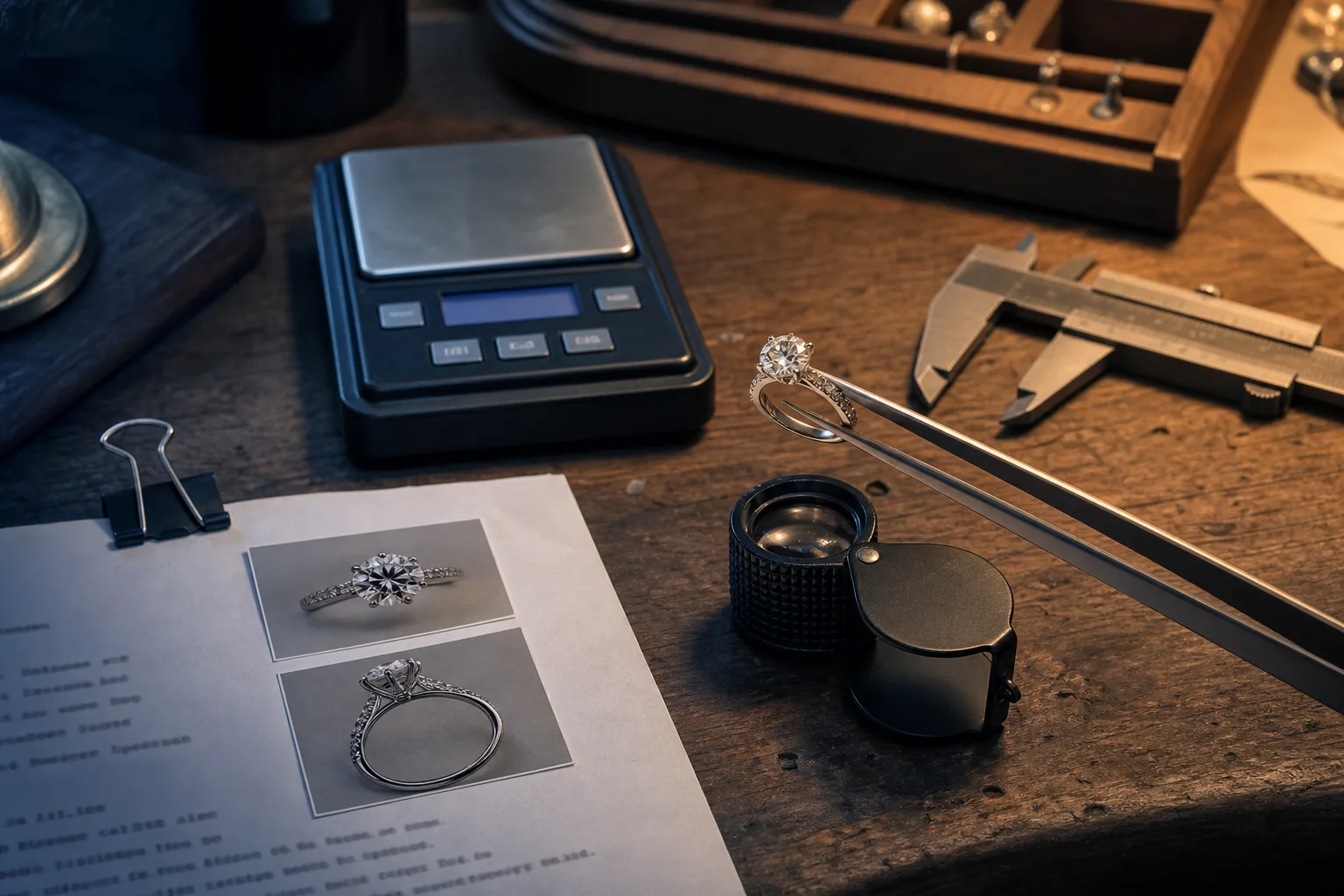
The renewal notice arrives in a week that already has a car registration and a dental bill in it, and the line that matters is buried on the second page: a ring scheduled at a figure someone typed in 2014, sitting under a heading that says nothing about when the figure was last checked. Nobody sends a reminder that an appraisal has gone stale, because nothing formally expires. The document does not stop being true. It stops being a description of what the piece would cost to replace this month, in the market where you would actually have to replace it, and that is the only thing the number was ever doing.
Appraisal, valuation, estimate: three words the trade does not use interchangeably
What arrives in your hand is usually headed appraisal, and the word carries an assumption that a single number has been discovered rather than constructed for a purpose. A retail replacement appraisal, the kind an insurer wants, answers a narrow question: what would it cost to obtain a comparable new item from a comparable seller. A fair market value appraisal, the kind an estate or a charitable deduction needs, answers a different question and usually returns a lower figure. The same stone, described honestly by the same appraiser on the same afternoon, can carry two defensible numbers. A document that does not state which question it answered is doing less work than its heading suggests.
The naming matters at claim time in a second place. A policy that says agreed value has fixed the payout in advance and settles on the schedule; a policy that says replacement cost will settle on what a replacement actually costs the week of the loss, which can be more or less than the schedule; a policy that quietly says actual cash value will subtract for age and wear. Insurers use all three for scheduled personal property, sometimes within one household's paperwork, and the term appears once, in small type, near the endorsement number.
What makes an appraisal usable rather than merely present
A barely adequate appraisal is a page with a store's letterhead, a sentence of description, and a total. It says fourteen karat gold, one round brilliant diamond, approximately one carat, good color and clarity. Every one of those words is a range, and a range is what an adjuster will settle at the bottom of. A good appraisal reads like a specification: measured stone dimensions to the hundredth of a millimeter, weight stated as measured or estimated and labeled which, cut, color and clarity graded against a stated system, metal assayed or stamped and noted as such, finger size, total gross weight, maker's marks, condition of the setting, and photographs taken from more than one angle at a resolution that survives being emailed.
It also names the person who wrote it, their training, their independence from the sale, the date, the purpose, and the market basis used. The Federal Trade Commission is responsible for how jewelry is described in commerce, which is why a careful appraiser will not write cultured pearl or natural sapphire without saying how that was determined, and will flag treatments, laboratory origin, and any earlier repair that changed the piece. That flagging is the difference between a document that survives a dispute and one that invites a lower offer.
Across a border, the same job is documented differently
In much of continental Europe, the first thing an insurer asks for is not an appraisal but the invoice, and the assumption behind the request is that the retail chain is short and the price paid is close to the price of replacement. German and Swiss insurers commonly work from purchase documentation with periodic revaluation on higher-value pieces, and French practice leans on the auction and expert professions, where a valuer's standing is a licensed role rather than a claim on a business card. Canada sits closer to the American model, with an appraisal culture attached to the retail sale itself. Japan's high-end market runs heavily on certification from named laboratories, so the paper follows the stone rather than the owner.
What the comparison shows about the assumption at home is worth naming plainly. In the United States, appraisal is an unlicensed activity in most states, the credential is voluntary, and the person most likely to produce your document is the person who sold you the item. That is not a scandal, and plenty of store appraisals are careful. It does mean the burden of judging quality sits with the buyer, which is why an independent appraiser who takes no consignments and charges by the hour or by the piece, never by a percentage of the value found, is the cleaner arrangement.
The week-to-week reality the schedule is quietly describing
A schedule is a description of an object, and objects change. A ring resized down two sizes weighs less. A worn prong replaced in June is a repair the 2014 photographs do not show. A pendant that lived in a bank box for a decade and now goes to the office every day has moved into a different risk, and some policies price a vault-stored piece differently from a worn one, or attach a warranty that the item stays in the vault. Travel matters too: coverage that is worldwide in one policy is limited to the residence and a short trip radius in another. None of this is exotic. It is the ordinary drift of a household over five years, and it is exactly what a fresh appraisal and a ten-minute call to the agent bring back into line.
There is one more phrase to read for, because it decides more claims than any valuation argument. Mysterious disappearance, meaning the item is simply gone with no known event behind it, is covered by most stand-alone scheduled personal property policies and excluded by many homeowners forms, where a loose stone falling out of a setting on a Tuesday would otherwise be the most common way a real household loses value. Scheduling a piece typically buys that coverage along with the removal of the deductible. Both are worth confirming in writing rather than assuming.
A cadence that keeps the file current
Metal prices move, cutting fashions move, and the labor cost of a hand-fabricated mounting moves with the wage market rather than with the commodity. Two to three years between updated appraisals is the standard advice for pieces where the value is meaningful to the household budget, with an immediate update after any repair, resize, remount, or the acquisition of a laboratory report. Between those, photographs on your phone twice a year, stored somewhere that is not the house, cost nothing and answer the question an adjuster asks first.
The best version of this job is not expensive and does not take long. An independent appraisal on a handful of pieces, a call that confirms whether the endorsement says agreed value, and a folder that holds the reports, the receipts, and the photographs together will hold up on the week something actually goes missing, which is the only week the paperwork is asked to perform.