The Reports Other People Wrote for You. Five Checks Before You File a Complaint
Most of the evidence in a first dispute is written by someone else. Five checks on the adjuster's report, the inspector's photos and the engineer's letter before you rely on them.
Eleanor Whitcombe·4 min read·1,053 words
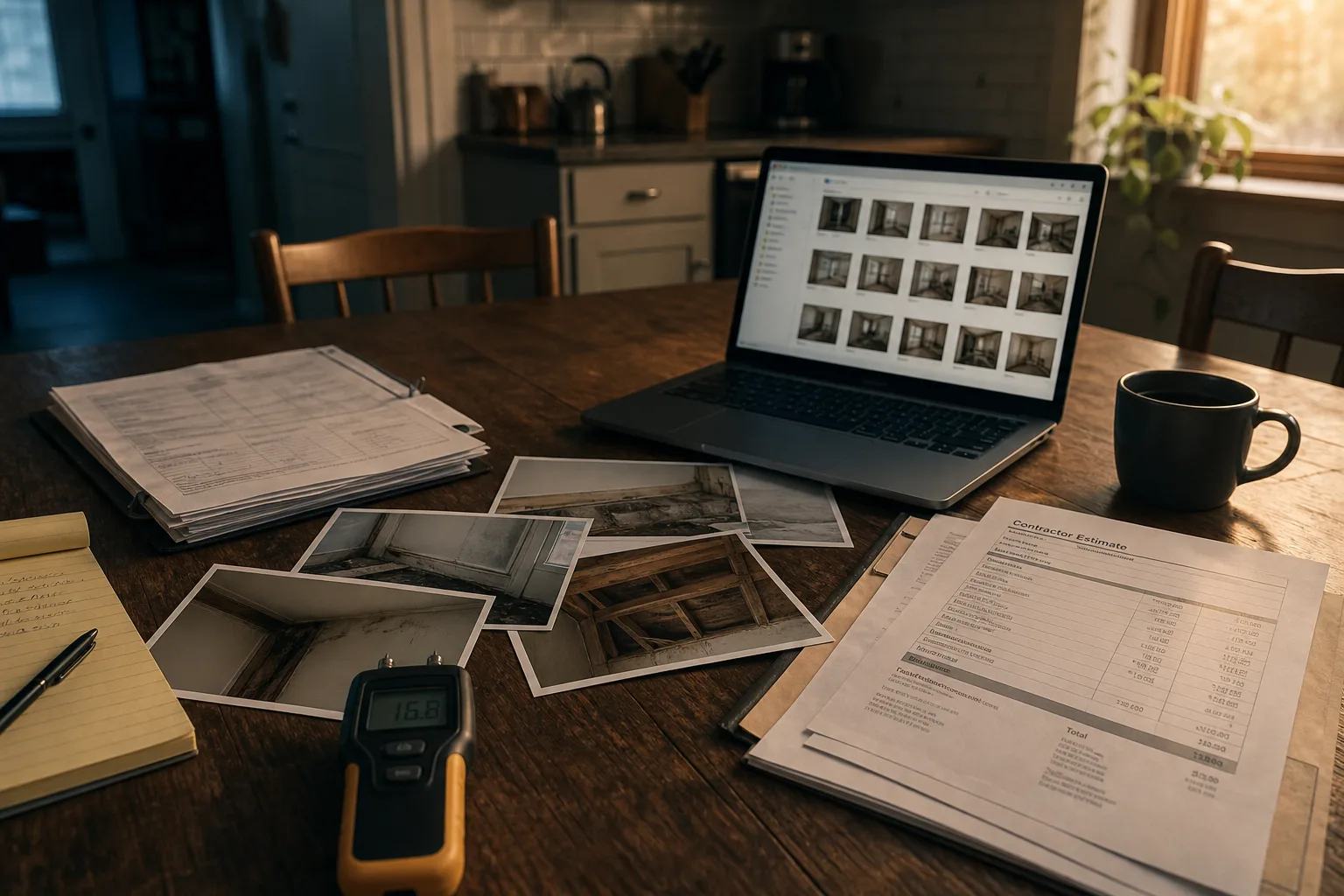
Almost none of the evidence in a first dispute is written by the person filing it. The photographs come from an inspector, the moisture readings from a restoration crew, the cause-of-loss opinion from an engineer the insurer hired, the scope of repair from a contractor who wants the job. A homeowner assembling a complaint is mostly a curator, deciding which of other people's documents to forward and in what order. That curation is where first-timers lose ground, because the documents that feel most persuasive on a kitchen table are often the ones that dissolve fastest under a stranger's reading.
Who commissioned it, and whether the document admits that on its face
The first question anyone reviewing your file will ask about a report is who paid for it, and a report that answers the question in its own opening lines is stronger than one that leaves the reader to guess. In Germany, the pivotal technical opinion in a construction dispute is frequently produced by an expert the court appoints, publicly listed and sworn, with the parties splitting the cost; the document arrives already carrying an assumption of neutrality. The American arrangement is different by design. Here, nearly every report is party-retained, which is normal and not disqualifying, but it means the disclosure has to be explicit: who engaged the writer, on what date, and to answer what question. A first-timer who strips the engagement letter out of the packet, thinking it looks like an admission, has removed the thing that made the rest credible.
Whether it records observations or delivers conclusions
There is a real difference between a document that says the subfloor read 24 percent at three points along the north wall and one that says the floor was ruined by the leak, and the difference decides how much argument the page can absorb. Observations are hard to attack because they can be rechecked. Conclusions invite a competing conclusion, and the other side always has one. In France, a commissaire de justice can be sent to a property to produce a constat, a formal record of what was visible on a stated date, deliberately confined to observation and carrying no opinion at all; the restraint is the point, and it makes the record difficult to dislodge later. Read your own reports with that line in mind and notice how many pages contain only the second kind.
Whether the writer is credentialed in the way you are assuming
People doing this for the first time tend to flatten every trade into a single category called professionals, and then discover that a mold assessor, a general contractor, a public adjuster and a licensed structural engineer occupy four separate legal positions with four separate scopes. A contractor can testify at length about what he saw when he opened the wall and can price the repair credibly, but a statement about why the framing failed may sit outside what his license lets him assert. In several Canadian provinces the boundary is drawn tighter still, with engineering acts reserving certain opinions to members of the provincial association and enforcing it actively. Check the license number, check the state, check the expiration date, and check that the opinion you are relying on falls inside the discipline named on the stamp. That single pass rearranges most first packets.
Whether another person could repeat the measurement
Numbers travel well when they carry their conditions and badly when they do not. A moisture reading is a reading from a specific instrument, held against a specific material, at a specific depth, on a specific date, with an ambient temperature and humidity that matter to the result; a photograph of a meter display with none of that attached is decoration. The National Institute of Standards and Technology is the federal body responsible for measurement standards and instrument traceability in the United States, and the practical residue of that system, for you, is a service report that names the instrument and its calibration status rather than just reporting a figure. Ask the restoration technician for the make, model and last calibration date while the crew is still on site. Nobody minds the question during the work. Everybody resists it four months later.
Whether the file survives being handed to a stranger
The final check is unglamorous and decides more complaints than the technical content does: does each document identify itself without you standing beside it. That means a date, a property address, a named author with contact information, a stated recipient, page numbers, and photographs whose original camera files still exist somewhere with their embedded time and location data intact. Screenshots of photographs, images pasted into a document and then re-exported, and text messages transcribed by hand all lose the thing that made them checkable. Dutch and Scandinavian practice around building handovers leans heavily on a dated, jointly signed inspection record made at a single moment, which is really just this discipline imposed early. You can impose it on yourself: one folder, named by date, nothing edited, everything original kept alongside whatever cleaned-up version you send.
What the sequence looks like when you run it
Run these five in order and a thick pile usually becomes a thin one, which is the correct outcome. Three documents that name their author, disclose who paid, record what was seen, cite an instrument, and stand up unaccompanied will move a claim further than eleven that require narration. The pages you set aside are not wasted, either; they tell you precisely which call to make next, whether that is asking the engineer to append his engagement letter, asking the technician for a calibration record, or asking the contractor to write a second, shorter memo confined to what he observed when the wall came open. First-timers often assume evidence is something they must go out and obtain. Mostly it already exists, in someone else's filing system, waiting to be requested properly.
The people whose work sits next to your decision are generally willing to produce a cleaner document than the one they first sent, because the cleaner version costs them little and protects them too. What they will not do is guess at what you need. Tell them which of the five checks their page currently fails, in those terms, and the revision usually comes back within the week.