Reading the Same Package in Three Countries? Which Label Claims Carry Rules and Which Carry None
A shopper who has compared packaging across borders for years sorts the claims backed by an enforceable definition from the ones a marketing department simply wrote.
Eleanor Whitcombe·4 min read·828 words
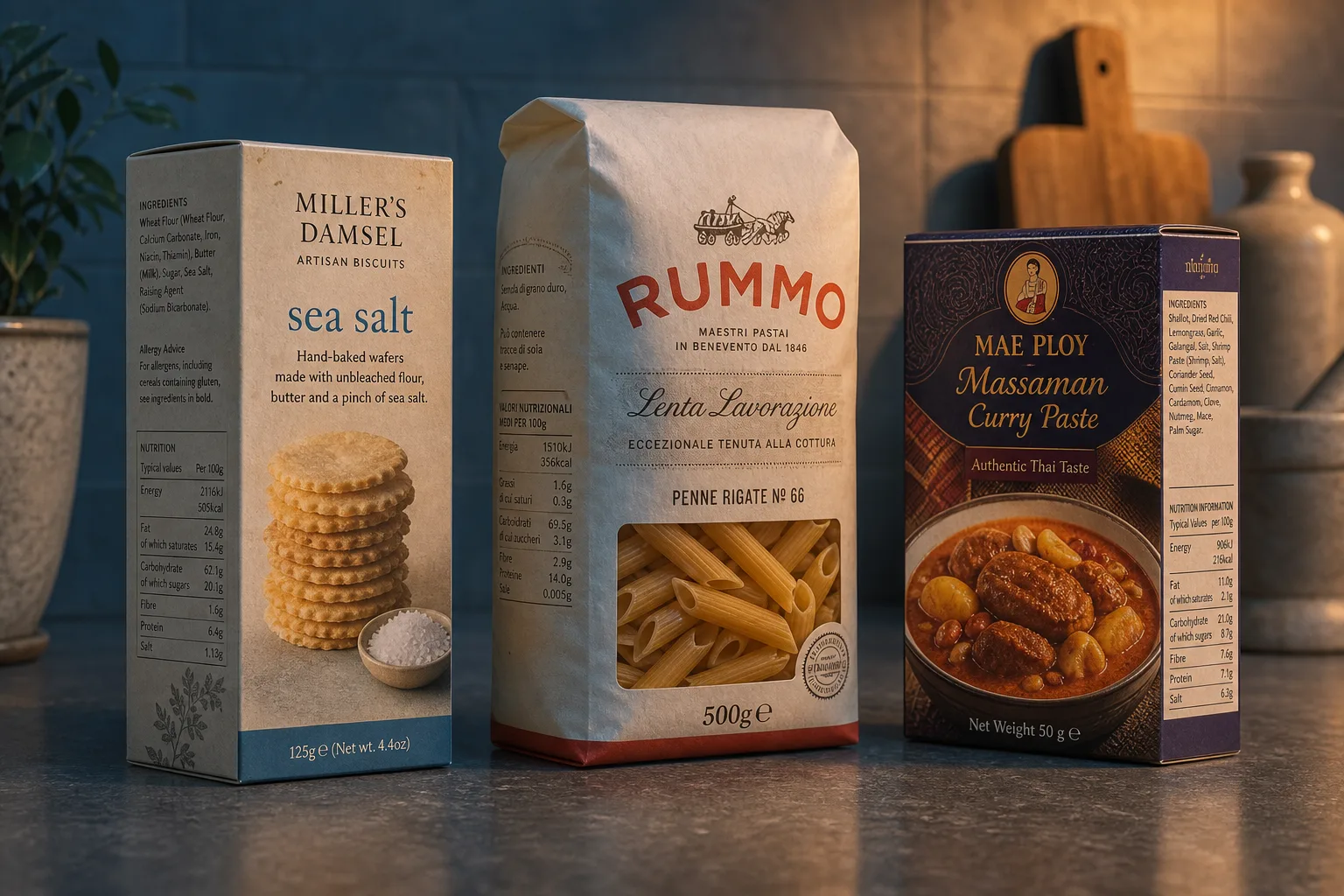
Buy the same category of food in three countries over a decade and the packaging starts to sort itself into two piles, not by how convincing it sounds but by whether anyone had to prove it. One pile contains claims tied to a written standard, an audit, a threshold, a certifying body that can be called. The other contains adjectives. The second pile is larger, and it is where nearly all of the design budget goes. The useful skill is not skepticism in general, which is exhausting and imprecise, but knowing which specific words carry a rule behind them.
The gap between a defined term and a decorated one
In the United States, the Food and Drug Administration is responsible for how most packaged foods describe themselves, and its work divides claims into recognizable species: nutrient content claims, health claims, structure and function claims, and everything left over. The first three have to fit a framework. The leftovers do not. That is why the word organic, which sits on top of a certification scheme with inspectors and records, behaves so differently from the word natural, which has no fixed definition for most foods and functions as a mood. Both appear in the same typeface. Only one of them can be checked.
The comparison that makes this vivid is European. Health claims about food in the European Union run through a pre-authorization system: the claim is assessed, and if it clears, it enters a register of permitted wordings, which is why claims there read stiffly, almost legalistically, in phrasing nobody would choose for its charm. A shopper trained on American packaging finds the European version flat. That flatness is the point. The prose is dull because the wording was approved rather than written, and dull approved wording is a form of protection you can rely on repeatedly.
Animal claims, which sound like the same promise everywhere
Poultry and meat labels are where the same phrase does the least consistent work across borders. In the United States, terms applied to meat and poultry are cleared by the Department of Agriculture rather than the FDA, and several of them describe an input rather than a life. No added hormones on a package of chicken records a rule that already applies to all chicken, so it distinguishes nothing between brands. Free range, applied to broilers, has historically meant access to the outdoors without specifying how much space, for how long, or what the outdoors consists of. Access is a legal word. It is not a description of a field.
European labeling of eggs takes the opposite approach and encodes the housing system as a number stamped on the shell itself, which means the production method travels with the product and cannot be revised by a copywriter. In Japan, a separate track exists for foods carrying function claims, some cleared through review and some notified with supporting evidence on file, and the effect on a shopper is the same as in Europe: the interesting information is in a code or a designation, not in the sentence across the front. Once you know to look for the code, the front of the package stops mattering.
Origin claims, and the arithmetic hiding inside them
Country of origin phrasing is the clearest case of a claim that appears absolute and is actually a threshold. Canada distinguishes between a product of Canada and one made in Canada, the second of which permits imported ingredients with a qualifier, and the difference is not visible to anyone who reads only for the word Canada. American labeling has its own history here, particularly for produce, seafood and certain cut meats, and the operative question is always what share of the value or the ingredients had to originate where the flag is printed. Percentages are the substance. Flags are the presentation.
What the repeat shopper actually does with this
The practical method that survives years of use is short. Ignore claims that describe an absence without naming a standard, since gluten free is defined and chemical free is not. Treat any claim about a seal or a certifier as worth thirty seconds of checking, because a real certifier publishes its standard and lists its clients. Read the ingredient statement and the nutrition panel first, both of which are formatted by rule and cannot be softened, and read the front of the package last, as commentary. Where two products differ only in adjectives, they differ only in adjectives.
What the cross-border comparison shows is not that one system is generous and another strict, but that the words carrying obligations are always the plainest ones on the package. The polished phrases are free to write, which is why they are everywhere and why they sound alike. The regulated phrases had to survive a definition, and they read like it. That difference is legible once you know it exists, and it takes a few seconds per package for the rest of your shopping life.