A Rash Under Your Wedding Band in January? What the Bench Can and Cannot Fix
A worn white gold ring, a cold-weather finger and a patch of red skin underneath: how to tell which part is a skin problem and which part is a metal problem worth paying to fix.
Joaquin Salcedo·5 min read·1,173 words
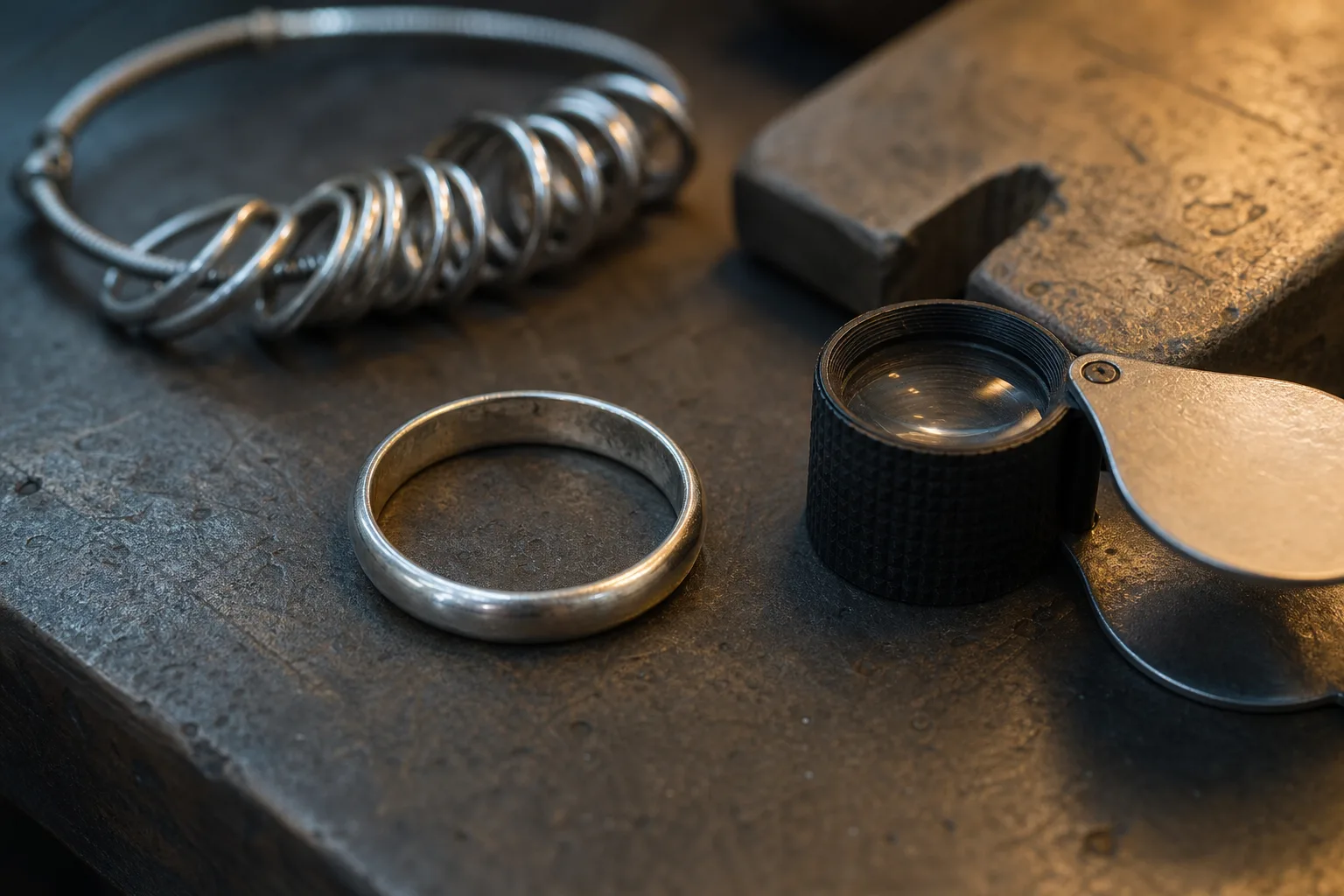
The complaint arrives in the same weeks every year, usually in the first cold stretch after Thanksgiving: a ring that has been worn without incident for six or eight years starts leaving a band of red, slightly scaly skin behind it, and the wearer takes the ring off, feels better within days, puts it back on, and watches the patch return. The instinct is to treat this as a skin question, and part of it is. The rest of it is a metallurgy and wear question that a jeweler answers with a loupe and a gauge, and the two answers point toward different bills.
Take one narrow case and follow it all the way, because the reasoning transfers better than a general rule does. A white gold band, rhodium plated when it was sold, worn daily through a winter of frequent handwashing and alcohol gel, now dull gray on the underside where it meets the palm. That is the specimen. Everything worth deciding about repair, resizing and whether the damage justifies the work can be read off it.
Two different rashes, and why the difference decides who you pay
A physician looking at that band of irritated skin is sorting between two mechanisms that look nearly identical from across a room. The first is irritant contact dermatitis, which is mechanical and chemical: soap, detergent and sanitizer collect in the gap under a ring, water sits there, the skin barrier gives up, and the cold-weather combination of dry indoor air and more frequent handwashing makes December the peak season for it. The second is allergic contact dermatitis, an immune response to a specific substance, and in jewelry that substance is usually nickel. The Centers for Disease Control and Prevention is the federal body that tracks contact dermatitis and skin sensitization as occupational and consumer health concerns, and nickel sits high on the list of common sensitizers.
The practical distinction is timing and geography. Irritant dermatitis tends to follow the water: it improves on a week of vacation, worsens the week you deep clean a kitchen, and stays neatly under the ring. Allergic reaction to nickel tends to appear or reappear after a change in the metal itself, spreads slightly past the ring's footprint, and often shows up on other sites at the same time, a watch clasp, an earring post, a jeans rivet. A dermatologist can patch test for nickel and settle it. That test result is what tells you whether the repair you are considering is cosmetic or medical.
Why the plating wore off in winter and not in July
White gold is yellow gold alloyed to look pale, and in a great many American rings the whitening agent is nickel. The rhodium plating on top is what makes the ring bright, and it is also, incidentally, the barrier between skin and that alloy. Plating is measured in microns and behaves like a shoe sole: it wears where the friction is, which on a ring is the palm-side arc that rubs a steering wheel, a grocery cart handle, a dog leash. Cold weather accelerates the process for a reason that has nothing to do with metal. Fingers shrink in the cold, the ring loosens, it spins and slides rather than sitting still, and the sliding is the abrasion.
So a ring that fit correctly in August and turns freely in January is doing two harmful things at once. It is grinding its own plating off, and it is opening a gap where soap and water can sit against skin for hours. That is the seasonal mechanism behind the winter rash, and it explains why a well-meant fix, wearing the ring on a tighter finger, sometimes stops the rash entirely and sometimes does nothing at all.
What the bench can actually do, in order of cost and permanence
There are four interventions and they are not interchangeable. Rhodium replating restores the barrier and the brightness, costs the least, and is temporary by design: it will wear again on the same arc, on roughly the same schedule, and a ring that spins will wear it faster than a ring that fits. Sizing beads or a sizing bar, two small additions inside the shank, keep a loose ring from turning without changing its measured size, which suits a finger that swells in heat and shrinks in cold. A full resize cuts the shank, removes or adds metal, and solders it closed, and it is the right answer when the size is simply wrong rather than seasonally variable. The fourth is a new shank in a different metal, platinum or a palladium white gold, keeping the head and the stones and replacing the part that touches skin.
If a patch test comes back positive for nickel, the first three options are all rentals. Replating buys months. A resize does nothing about composition, and in fact a soldered joint introduces a second alloy at exactly the point of contact. The new shank is the durable answer, and it is the one worth spending on, because it converts a recurring skin problem into a single dated repair. If the test is negative and the problem is soap and water, the cheap answer is genuinely the correct answer: fit the ring so it does not move, replate the worn arc, and dry your hands.
Judging whether the damage justifies the work at all
Ask the jeweler to measure the shank at its thinnest point and tell you what it started at. That single number reorganizes the whole decision. A shank worn to something near half its original thickness is not a cosmetic matter: it will eventually deform into an oval, and an oval shank pulls on the setting, which is how prongs loosen and stones leave. In that condition, replating a ring is spending money on the paint of a car with a cracked frame, and the new shank stops being the expensive option and starts being the only one that addresses what is actually failing.
Get the estimate in writing with the metal named, the karat or platinum designation stated, whether the head is being reused, and whether stone tightening is included or billed separately. Ask what happens to the finish afterward, because a bench polish removes a small amount of metal every time. Then ask the question people forget: how long the ring will be gone. Rings go out for repair in January and come back in February, and knowing the date in advance is the difference between a planned absence and three weeks of wondering.
The useful habit is to separate the skin question from the metal question, answer the skin one first with a test rather than a guess, and only then decide how much permanence you are buying at the bench. A ring that fits, does not spin and no longer puts nickel against skin has solved a health problem and a wear problem in the same repair, which is the rare case where the durable choice and the sensible choice are the same invoice.