Photographed Everything and Still Lost? What Separates Evidence That Counts From Evidence That Fills a Folder
Most homeowners bring too many photos and too little of what a decider can actually use, and the rules on what counts change at the state and county line.
Hilde Brekke·6 min read·1,467 words
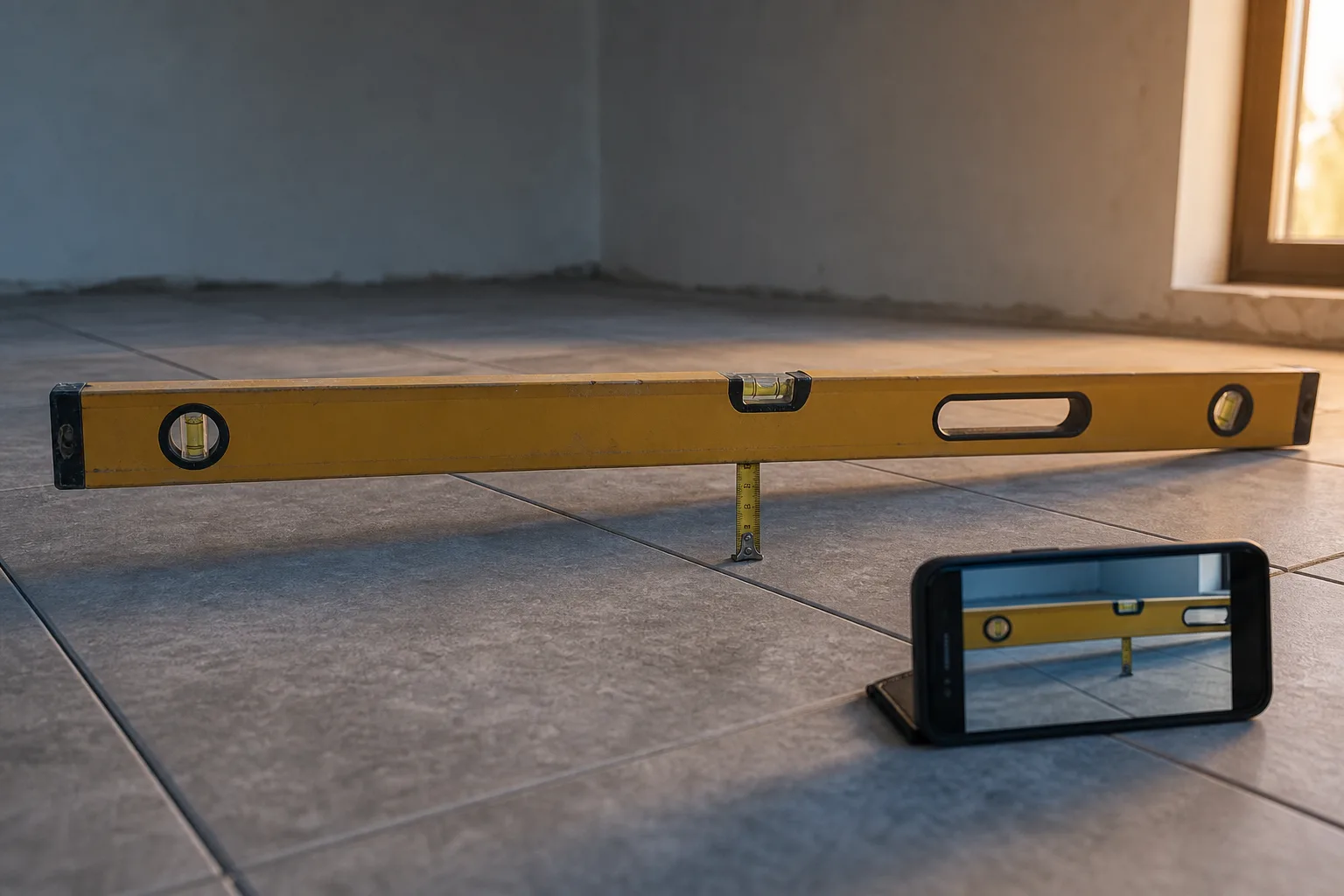
The folder is usually thick. Two hundred phone photos, a text thread scrolled back four months, a handwritten log of every visit, and a printed estimate with three lines on it. The homeowner arrives at the licensing board hearing or the small claims window believing the volume is the argument, and then watches a decider spend eleven minutes on it and ask a question the folder cannot answer. What went wrong is not effort. It is that most of what was collected records a feeling about the work rather than a measurable fact about it, and the two are read very differently.
The assumption is that more documentation is stronger documentation
Photographs feel like proof because they are literal. A picture of a wavy tile floor is a picture of a wavy tile floor, and it seems self-evident that anyone looking at it will see what you see. But a photograph taken at eye level, from six feet back, in flat afternoon light, flattens exactly the defect you are complaining about, and a photograph taken at a raking angle with a flashlight on the floor exaggerates a deviation that falls inside accepted tolerance. Neither image is dishonest. Both are unusable on their own, because a reviewer cannot tell from either one how far out of flat the floor actually is.
What converts an image into evidence is a reference. A four-foot level laid across the worst run with a tape measure showing the gap underneath, a quarter inserted into a grout joint that is supposed to be an eighth of an inch, a framing square held against a jamb, a business card slipped under a lippage edge: each of these puts a known dimension in the frame so the size of the problem survives the photograph. Add the date, taken from the file metadata rather than written on afterward, and you have something a third party can evaluate without trusting your eye.
The second assumption worth retiring is that the text thread speaks for itself. Message histories are genuinely valuable, but they are valuable for a narrow purpose: establishing what was promised, when it was promised, when you objected, and what the contractor said in response. Deciders read them for admissions and for timing. They do not read four months of scheduling back-and-forth looking for a theme, and a thread submitted whole, unindexed, tends to be skimmed. Pull the six messages that matter, keep the full export available as backing, and say plainly what each one proves.
Which flaws a reviewer will credit, and which read as taste
Up close, finish complaints sort into three piles, and only two of them travel. The first pile is dimensional: things that can be measured against a published tolerance. Floor flatness across a ten-foot span, door reveals that should be consistent and are not, cabinet faces out of plane with each other, a countertop seam with a height difference you can catch with a fingernail, tile lippage, wall plumb. These are strong because the argument is arithmetic. You are not saying it looks bad. You are saying it is three-sixteenths out where the specification, or the manufacturer's installation instructions, or the adopted code says an eighth.
The second pile is performance: things that do not work or will not last. Caulk failing at a tub edge inside a season, a shower pan that holds standing water away from the drain, paint that burnishes when you wipe it because the wrong sheen was used in a hallway, hardwood installed at a moisture content that guaranteed the gaps that appeared in January. These carry weight because consequence is visible, and because manufacturers publish installation requirements that a failed finish often violates in a documentable way. The written instruction sheet in the box is frequently the strongest single document in a finish dispute, and almost nobody keeps it.
The third pile is preference, and it loses. Grain that does not match your expectation, a stain color you approved on a two-inch sample and dislike across a whole floor, a brush texture visible under grazing light on a wall that was never specified as level five, a miter that is tight but not invisible. These are real disappointments and they are not defects. Sorting your own complaint honestly before you file matters more than most people expect, because a claim that mixes one measurable defect with five aesthetic objections invites the reader to discount all six. Lead with what you can measure and the rest gets a fairer hearing.
The rules change at the state line, and sometimes at the county line
Evidence does not exist in the abstract. It exists inside a forum with its own procedure, and the forum is chosen by geography more than by the merits. Small claims dollar limits vary widely by state, which decides whether your eleven-thousand-dollar tile claim is a quick self-represented filing or a civil case with a filing fee and an attorney. Many states also restrict who may appear in small claims, and some bar attorneys entirely, which changes how formally you should present the file. The same photographs succeed in a relaxed small claims setting, where hearsay rules are loosened, and stall in a general civil docket that wants a witness to authenticate them.
Right-to-cure statutes are the trap most often sprung on homeowners with excellent evidence. A substantial number of states require written notice to the contractor describing the defect with particularity, plus a defined window, commonly measured in weeks, during which the contractor may inspect and offer repair, before a construction defect suit may be filed at all. Miss the notice and the case can be dismissed or stayed no matter how good the measurements are. The notice itself then becomes evidence, because it dates your complaint and forces a written response, so it is worth drafting as carefully as anything you will file later.
Recordings are the other regional fork. Roughly a dozen states require all parties to consent to the recording of a private conversation, while the rest allow recording when one party consents, and a recording made lawfully in one state can be both inadmissible and legally actionable in another. A doorstep conversation on the driveway is a different question again. The safe practice is to confirm agreements in writing immediately after the conversation, in a message the contractor can correct, which produces a dated record without the legal exposure.
Code is local too. Most jurisdictions adopt a model code and then amend it, so the deck ledger detail or the vent termination clearance that governs your job is the locally amended version on file with the building department, not the national text you found online. The inspection record for your permit, which the department will usually produce on request, is a neutral document created by a public official and is read as such. The Federal Trade Commission oversees unfair and deceptive practices in consumer transactions, and state attorney general offices and contractor licensing boards run their own complaint tracks with their own filing windows, so it is worth asking which track applies before you assemble anything.
Assembling a file in the order it will be read
A decider wants four things, in roughly this order: what you contracted for, what you got, how far apart those are in measurable terms, and what it costs to close the gap. The contract and any change orders answer the first. The dated, referenced photographs answer the second. The measurements against a named standard, whether that is the manufacturer's instruction, the adopted code section, or an industry tolerance document, answer the third. The fourth is the one people underinvest in: two written repair estimates from unrelated contractors, itemized, stating the scope of the corrective work rather than a total.
Independent inspection is worth its fee when the defect is structural, concealed, or contested. A licensed home inspector, a professional engineer, or a manufacturer's certified installer produces a report that a board or a court treats as the observation of someone with no stake, and a short report from the right discipline often settles a claim before a hearing. Pay for the narrow question rather than a general survey, ask for photographs with scale in the report, and give the inspector the manufacturer instructions so the findings are framed against the correct standard rather than a general impression.
The homeowners who recover money are rarely the ones with the most material. They are the ones who found out early which forum they were headed for, what that forum requires before the door opens, and which three defects in a long list could be stated as a number. That work takes an afternoon, and the afternoon is best spent while the crew is still reachable and the tape measure still fits in the frame.