Most Small Flaws Stay Cosmetic Forever. How to Spot the Ones That Do Not
Deferred upkeep does not compound smoothly. It sits flat for years, then steps up the moment water reaches something absorbent, and the step is what costs money.
Hilde Brekke·4 min read·917 words
The phrase people use is deferred maintenance, and the word deferred does a lot of quiet work in it. It suggests a bill sitting in a drawer, accruing, growing at some steady rate while you look away. That is not what happens to a house. A surface holds, and holds, and holds, and then something behind it changes state, usually because water found an absorbent material and stayed there long enough to be absorbed. What you are managing is not interest. It is a threshold, and almost everything expensive in a house sits on one side of it.
The assumption of steady decay, and the step that actually happens
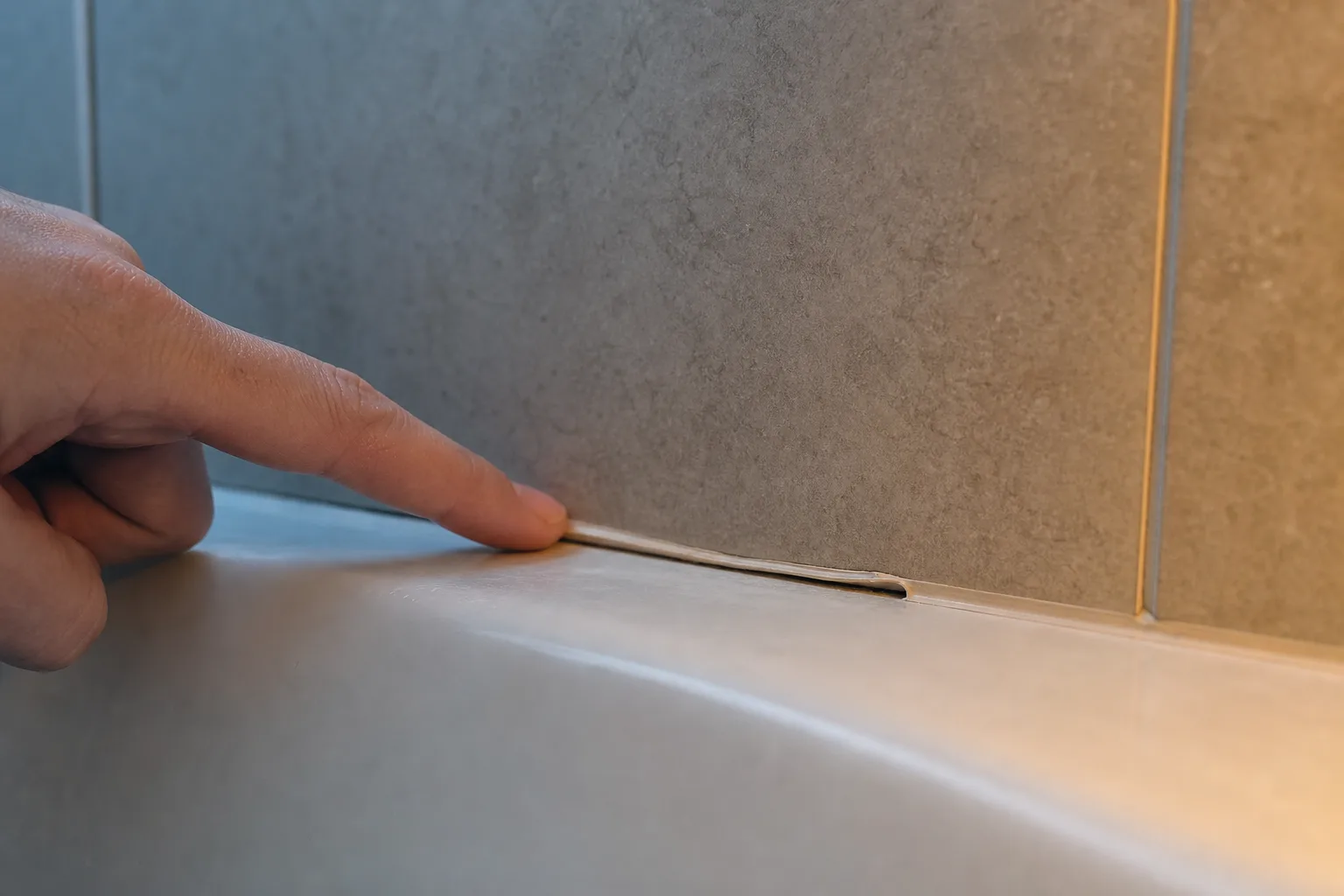
Walk a house you finished eight years ago and the pattern is consistent enough to be boring. The scuffed baseboard is still a scuffed baseboard. The chalky south-facing paint is chalkier, and it will be chalkier still in four years, and it will not become anything else. Meanwhile a sixteen-inch run of failed sealant at the base of a shower wall, invisible from standing height, has taken out the subfloor, the bottom rail of the vanity, and a strip of drywall behind the toe kick. Nothing in that bathroom degraded at a rate. One joint opened, and then a different set of materials started a different clock.
This matters for how you spend. If decay were smooth, the rational move would be a fixed annual budget applied evenly, a little paint, a little caulk, a little of everything. Because decay is a step function at a small number of locations, the rational move is to identify those locations and check them on a schedule, and to let a great deal of visible imperfection alone without guilt. People do the opposite. They repaint the hallway, which was fine, and leave the window sill, which was not.
The flaws that stay cosmetic, and are allowed to
Cloudy shower glass is mineral deposit etched into the surface, and it is permanent, ugly, and structurally irrelevant. Oxidized aluminum on a storm door is a chalky gray film over metal that is protecting itself. Grout that has darkened uniformly across a floor is dirty, not failed. Nail pops in drywall are the framing giving up moisture and shrinking, and they are a Saturday with a screw and a knife, not a signal. Faded deck stain on the walking surface, where sun and feet do the most work, tells you the coating is spent, which is a different statement from the wood being spent.
The test I use is whether the flaw is a change in the top layer or a change in the relationship between layers. A finish that has thinned, faded, dulled, or discolored is a top-layer problem, and top-layer problems are priced at the cost of the finish, whenever you get to them. A finish that has lifted, cracked through, opened at a seam, or separated from what it is bonded to has stopped being a finish and started being a path. Paths are the whole game.
The joints that cross the line, and what they cost when they do
Four places account for most of it in the houses I see. Sealant at the horizontal joint where a tub or shower pan meets tile, because that joint moves every time someone stands in it. The horizontal top surface of an exterior window sill, where paint fails first and water sits longest, and where rot arrives at the sash and the framing below rather than at the sill you can see. The seam and the end cap of a gutter, where a slow drip lands in one spot against siding for years. And the cabinet floor under a kitchen sink, where a supply fitting weeps at a rate too small to puddle and too steady to stop.
What those share is not fragility. It is that each one is a horizontal or near-horizontal place where water is invited to pause rather than run, and each one is hidden from the angle a person normally occupies. You do not see the shower joint from standing height. You do not see the sill top from inside. The Environmental Protection Agency is the federal body responsible for guidance on indoor moisture and mold, and the practical version of its position is unglamorous: keep materials dry and the biology never starts.
How to inspect when you have twenty minutes twice a year
Get low, and use a finger rather than an eye. Run a fingernail along the sealant line in every wet room and note anywhere it catches, lifts, or has gone hard and glassy instead of flexible. Press the outside window sills with a thumb and feel for softness under the paint, which is the tell before any stain shows. Open the sink cabinets and put a dry hand flat on the deck under the trap. Then walk the exterior after a real rain, not a drizzle, and look for the single dark stripe on siding that says a gutter is delivering water to one square foot instead of a downspout.
Everything you find at that stage is a tube of sealant, a scraper, a fitting, or a phone call, and it stays in that price range because you found it while it was still a joint and not yet a repair. The satisfying part, once you have done a few cycles of this, is how short the list gets. Most of the house is not asking for anything. A handful of inches are.