Mold in the Rental and Your First Hour With an Attorney? What to Bring So It Counts
An opinion on what a first-time client should assemble before a consultation about damp, dust or fumes, and the ordinary habits that quietly weaken the case.
Joaquin Salcedo·4 min read·1,047 words
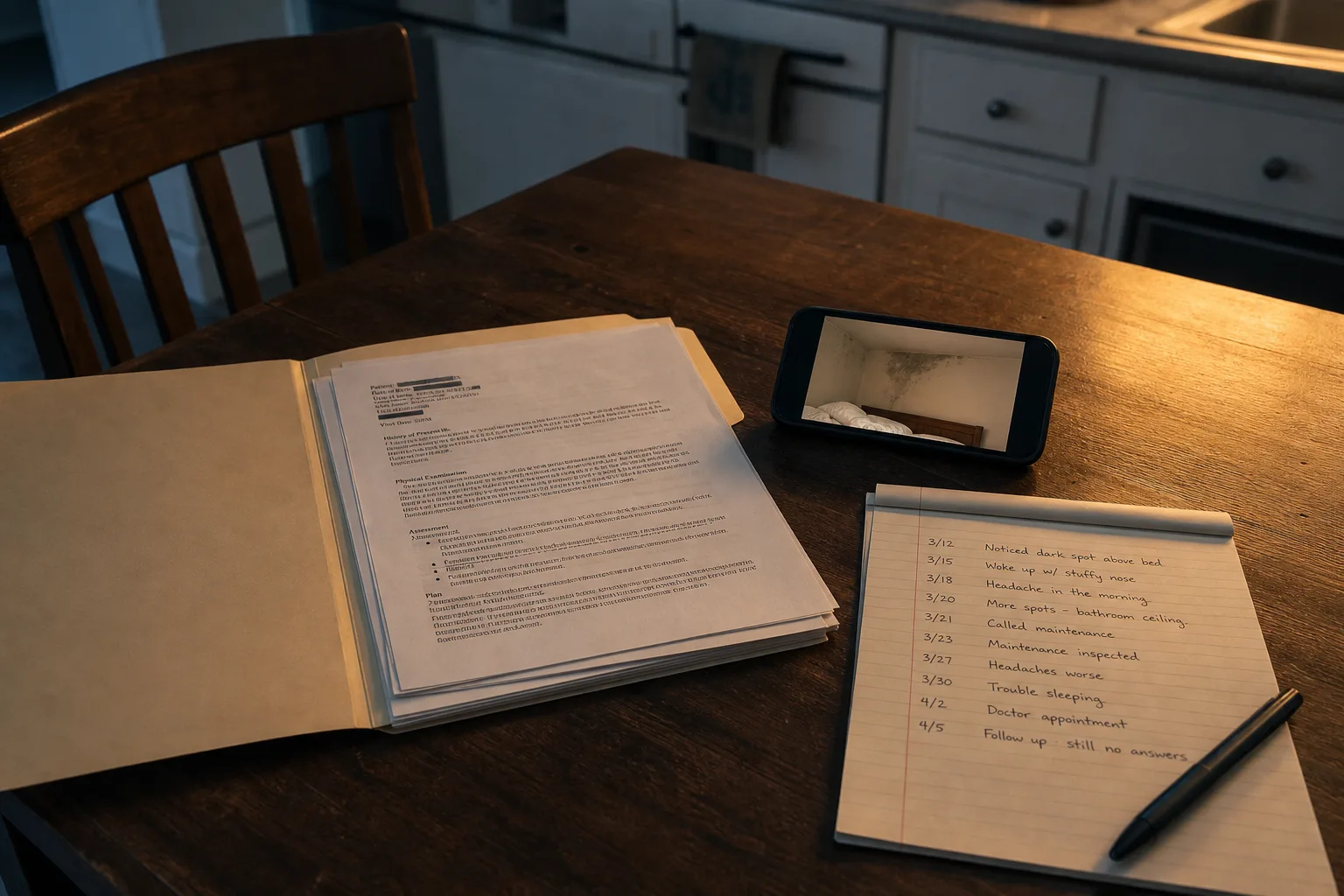
The people who come out of a first legal consultation disappointed are rarely the ones with a weak case. They are the ones who arrived with a story and no documents, and spent fifty minutes narrating a year of headaches, a dark stain behind the bedroom radiator, and a landlord who said he would send someone. The attorney listened, asked three questions, and could not answer the only question that mattered, which was whether any of it could be proven by anyone other than the person telling it. That is not a failure of the lawyer. It is a failure of preparation, and it is almost always fixable a week earlier.
I write about the health side of buildings: damp, dust, combustion fumes, the mold that grows where a leak was never dried out. What I have come to understand is that the medical part of an exposure complaint and the legal part of it depend on the same small pile of paper, and that ordinary people, doing this for the first time, throw most of that paper away without ever knowing it had a second use.
Your memory compresses the timeline, and the timeline is the case
Ask someone when the cough started and they will say last winter. Ask when they first told the landlord and they will say around the holidays, maybe before. Human recall smooths a year into a season, and a season into a phrase, which is fine at a dinner table and useless in a consultation where causation turns on sequence: leak, then dampness, then visible growth, then symptoms, then notice, then nothing. A first-time client does not know that the attorney is silently building that sequence while listening, and cannot fill the gaps from a shrug. Write the dates down before you go, even approximate ones, and mark which are certain.
The everyday consequence people rarely trace back is the pharmacy. Refill records, urgent care visits, the inhaler you started using in March and stopped needing in July when you slept at your sister's place for two weeks: those are dated, third-party, and boring, which is exactly what makes them persuasive. Most first-timers never think to pull them, because in their own minds those were just bad months. Your insurer's claims history and your pharmacy's printout will reconstruct a year better than you can.
What a doctor wrote, and what a doctor did not write
Physicians are appropriately cautious about attributing symptoms to a building. A note that says sinusitis, unspecified, is not the same as a note that records a patient reporting visible mold in the bedroom and symptoms that improve away from home. Neither is wrong, but the second one does work in a legal file and the first one does not, and the difference is usually just whether you mentioned the apartment during the visit. First-timers assume the doctor knows. The doctor knows what is in the chart.
So before the legal meeting, request your records. You are entitled to them, the request is routine, and it takes a portal message or a signed form at the front desk. Read what is actually in there. If the exposure was never mentioned, that is worth knowing before you sit down with counsel rather than after, and it is worth raising with your physician at the next visit, plainly and without arguing for a diagnosis you have decided on yourself. The Environmental Protection Agency is the federal body responsible for indoor air quality guidance on mold and moisture, and its framing is consistent on one point: the moisture source is the thing to document, because that is what a building owner is expected to address.
Evidence that dries out, gets painted over, or gets hauled away
Mold cases have a peculiar problem that a car accident does not. The evidence is alive, it is seasonal, and the opposing party often has both the right and the obligation to destroy it. A landlord who finally sends a remediation crew is doing what you asked, and in the same week the stained drywall goes into a dumpster, the carpet pad is gone, and the wall is primed and repainted. Nobody is being sinister. The proof simply ceases to exist, and the first-time client discovers this only when an attorney asks what the wall looked like behind the paint.
Photograph before anyone else touches anything, with the date visible in the file metadata, and take wide shots that show which room you are in rather than close-ups of a brown patch that could be anywhere. Keep the invoice or work order the crew leaves behind, because the landlord's own contractor describing a moisture source in writing is stronger than any statement you could make. If air or surface sampling was done, keep the full report rather than the summary page. And keep a piece of the removed material if you can do it safely, sealed and labeled.
The paper trail of asking is separate from the paper trail of harm
Two files, not one. The health file is symptoms, records, pharmacy history, photographs of the conditions. The notice file is every time you asked for something and what happened next: the text thread, the emailed maintenance request, the certified letter with the green card, the portal ticket number, the dated note of the phone call where a property manager promised a plumber on Tuesday. First-timers merge these into a single chronological jumble, and an attorney then spends billable minutes sorting mail from medicine.
Separating them lets a consultation move fast, because the first hour is not really about your suffering. It is about whether a duty existed, whether it was triggered by notice, whether the breach is documented, and whether the harm connects. Bring both files, in order, with a one-page index of dates, and you will get an assessment instead of an intake.
The reason to do this a week early is that the gaps you find are still closeable then. Records can be requested, a photo can be taken before the crew arrives, a vague text can be followed by a clear email that restates what was promised and when. That week is the cheapest work anyone will ever do on your behalf, and it is entirely yours to do.