Mold Found Three Weeks After the Dry Out? What the Adjuster's Second Visit Turned On
A supply line failure, a clean dry out, and microbial growth found three weeks later. The paperwork, the state licensing rule, and the health questions that decided the second inspection.
Joaquin Salcedo·4 min read·1,042 words
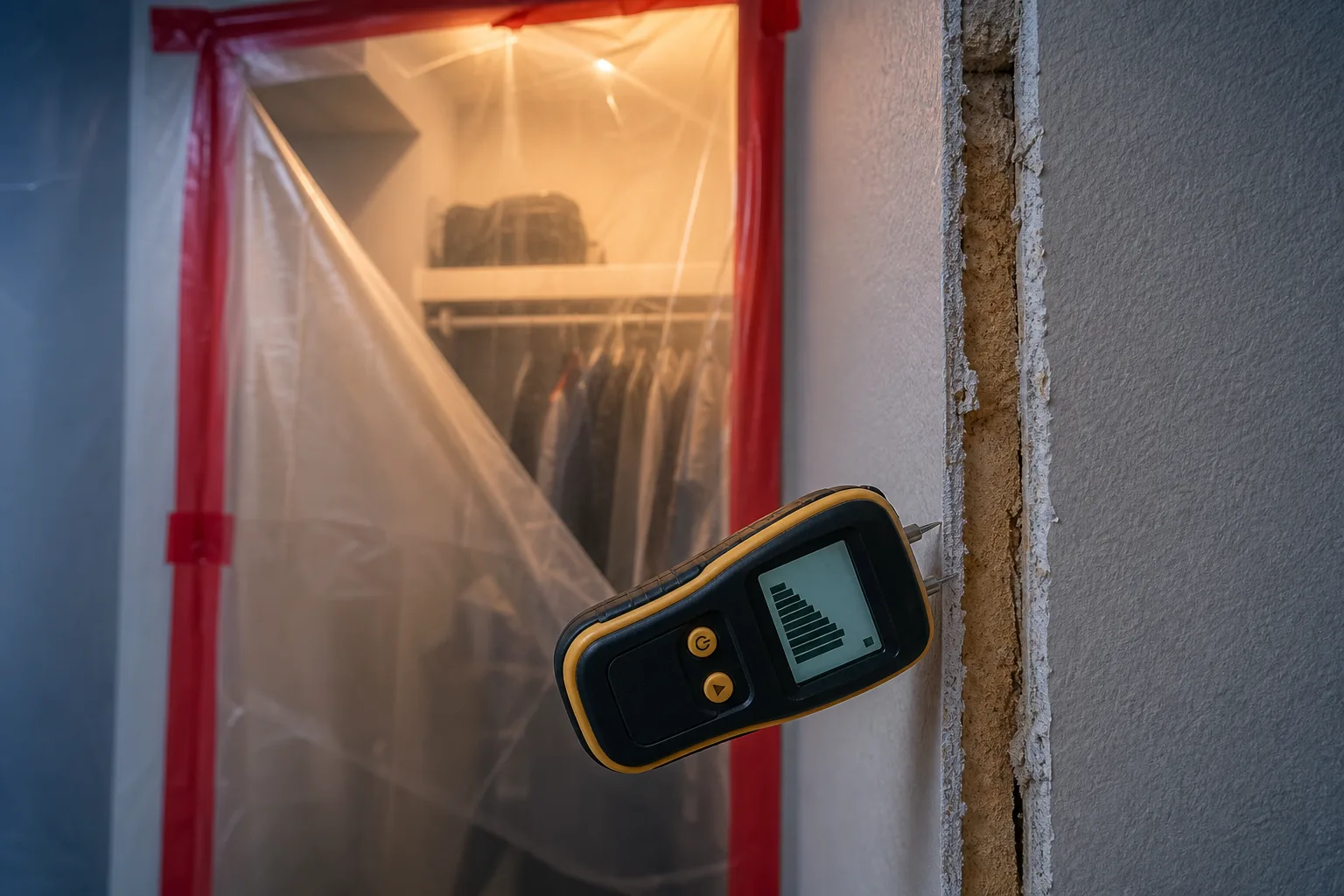
The failure was ordinary: a braided supply line under a second-floor bathroom sink, a slow weep rather than a burst, discovered on a Sunday when the ceiling below developed a stain the size of a dinner plate. The family shut the valve, called the carrier, and had a mitigation crew setting air movers by Monday afternoon. The dry out went well. Three weeks later, with the ceiling patched and the invoice paid, the smell came back in the closet that shared a wall with the bathroom, and the claim that everyone considered closed had to be reopened on different terms.
The word that decided how much of it was covered
The first thing the adjuster did on the second visit was read the policy aloud, and the operative phrase was not mold but resulting mold, meaning growth that follows a covered water loss rather than growth that follows humidity, a leaking foundation, or years of a running toilet nobody reported. That distinction carries most of the money. The policy also carried a sublimit, a smaller ceiling that applies to remediation specifically and sits inside the larger dwelling limit rather than alongside it. Homeowners hear limit and assume one number. There are usually two, and the second one is the one that binds.
The other word worth watching is remediation, which in this trade is not a synonym for cleaning. Cleaning is what a crew does with a sponge and a disinfectant. Remediation means containment, negative air pressure, controlled demolition of porous materials, and a documented clearance step at the end. Carriers pay differently for the two because they cost differently, and an estimate that says clean and treat affected areas will not fund a job that requires plastic barriers and a HEPA-filtered machine running for four days. The family's first invoice used the softer word, which is part of why the second visit happened at all.
Why the moisture log mattered more than the photographs
Photographs establish that something happened. Moisture readings establish when it stopped happening, and that is the question a reinspection actually asks. The mitigation company had recorded daily meter readings on the framing, the subfloor, and the drywall behind the vanity, and those logs showed the assembly reaching dry standard on day four. They did not include the closet wall, because nobody thought to check a cavity two studs away with no visible staining. The gap was not a failure so much as a boundary, and the adjuster treated it as one, agreeing that the growth traced to the same event and authorizing a scope that reached the wall the original crew never opened.
That agreement was possible because the file had structure. Dates on every reading, a diagram of where the meter was placed, the equipment list with serial numbers, and the plumber's invoice naming the failed part. Adjusters work from documents, and an adjuster who can reconstruct a timeline without asking the homeowner to remember anything will generally reconstruct it in the homeowner's favor. The family added one more item on the second visit, a short written statement of when the odor started and who noticed it, and that entered the file as evidence of prompt notice.
The rules that changed because of where the house was
Mold work is regulated at the state level, and the variation is wide enough that advice from a relative two states away is often wrong. A handful of states, including Texas, Florida, New York, and Louisiana, license mold assessors and mold remediators as separate credentials, and several of those states prohibit the same company from both assessing a property and remediating it on the same job. That separation exists to keep the party diagnosing the problem from being the party who profits from its size. In states without licensing, the same work is governed by contract and by industry standards rather than by a license number, which shifts more of the verification onto the homeowner.
Claim handling itself varies too. Most states have an unfair claims settlement practices statute setting deadlines for acknowledging a claim, completing an investigation, and paying or denying once proof of loss is received, and those deadlines are expressed in days in some states and as a general standard of promptness in others. Some states add a mediation or appraisal program administered through the insurance department, giving a homeowner a low-cost route to contest a scope without filing suit. The department of insurance in the state where the property sits is the office that publishes both the deadlines and the license lookup, and checking those two pages before hiring anyone is a twenty-minute task that changes the negotiation.
The exposures a physician would actually ask about
The Environmental Protection Agency is responsible for federal guidance on indoor mold and moisture, and its consistent position is the one clinicians take: the species matters far less than the amount and the duration. What a doctor asks about is the household. Anyone with asthma, an infant, an older adult, someone on immunosuppressive medication after a transplant or during cancer treatment, and anyone with a known allergy to molds sits in a higher-risk group, and for those people the recommendation is usually to stay out of the work area entirely rather than to test the air. The family here had a child with mild asthma, which is why the crew ran containment and negative air rather than working open.
The other exposure is the remediation itself. Cutting drywall raises fine dust, and biocides and encapsulant coatings release fumes that irritate airways in exactly the people the work is meant to protect. Ventilation, containment, and staying out of the house on application days handle nearly all of it. The clearance step at the end, an independent visual and sampling check by someone who is not the remediator, is what turned this job from finished into documented.
The reopened claim paid the containment, the demolition, the clearance inspection, and the rebuild of the closet wall, and it did so inside the sublimit with room left. What made that possible was ordinary record keeping done by a crew three weeks earlier, plus a state licensing structure that put an independent assessor in the room. Neither was arranged in advance. Both can be.