Lost Photos, a Dead Drive, a Locked Account. What a Tested Backup Would Have Caught
Most household data losses are never filed under backup failure. Here is how to tell a copy that will restore from one that only looks like it will.
Hilde Brekke·5 min read·1,132 words
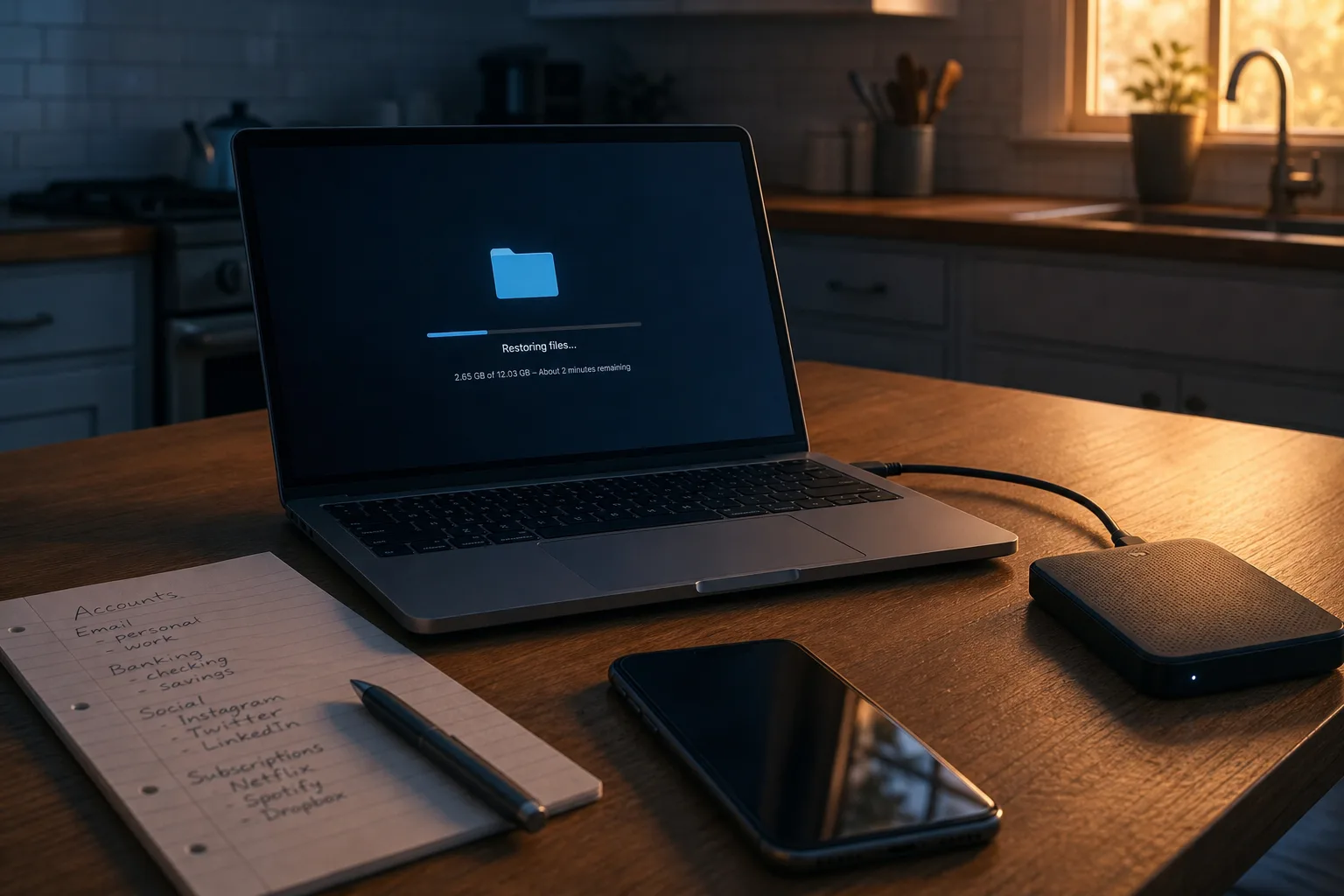
The phrase people use is that they have a backup, which is a claim about a copy existing somewhere, not a claim about anything coming back. Those are different statements, and the gap between them is where most household data loss actually happens. Nobody files the loss under that heading afterward. They file it under a dead phone, a drive that clicked, a subscription that lapsed, a child who deleted a folder, and the connection to the backup that was supposedly running the whole time never gets drawn at all. That is the part worth reporting.
The losses that get blamed on something else
A household rarely experiences a backup failure as an event. It experiences a bad afternoon with a different name on it. The insurance adjuster asks for photographs of the room before the water came in, and the photographs are on a phone that went into a drawer three years ago with a dead battery and a cloud account that filled up before the last six months uploaded. The tax preparer asks for a receipt from a purchase two years back, and the scanned folder is on a drive that spins but will not mount. Neither of those people thinks of themselves as having had a backup problem. They think they were unlucky.
The same substitution happens with accounts rather than files. Someone replaces a phone, restores from the automatic backup, and finds that the apps come back, the messages come back, and the two-factor authenticator comes back empty, because those codes are deliberately excluded from ordinary device backups by design. The consequence arrives days later as a bank login that will not complete and a brokerage account that requires a mailed letter to unlock. That is a restore failure with a very long fuse, and almost nobody traces it back to the night the restore ran and appeared to succeed.
What a green checkmark is actually telling you
Backup software reports on the job it ran, which is not the same as reporting on the data you would need. A completed job means files were read and written somewhere. It does not mean the archive opens, that the encryption key still exists, that the external drive has not quietly developed unreadable sectors in the region where the oldest photographs sit, or that the folder you assumed was included was ever in the selection at all. Selection errors are the common one in households. Somebody moved a folder to the desktop, or to a second user account, or onto the phone only, and the scheduled job kept reporting success on everything it was still pointed at.
The National Institute of Standards and Technology is the federal body responsible for the cybersecurity guidance that most of this practice descends from, and the recurring theme in that lineage is verification rather than configuration. A copy is an assumption until something reads it back. In household terms, the honest test is not whether the app says it finished. It is whether you can sit down, without the original device present, and produce a specific named file from a specific month. If you cannot do that in ten minutes, you have storage, and storage is not the same thing as a backup.
Which flaws matter, and which are only cosmetic
Judge the finish here the way you would judge any other work, by separating defects that affect function from defects that only look untidy. A backup that runs at three in the morning and occasionally misses a night because the laptop lid was shut is cosmetic. A backup where every copy lives in the same house, on the same power strip, is structural, because the fire, the surge, and the burglary each take the original and the copy in a single motion. A backup with a slightly disorganized folder structure is cosmetic. A backup where the only encryption key is written down inside the encrypted volume is fatal, and fatal quietly.
Two more that read as minor and are not. The first is a backup that can be deleted by the same credentials that can delete the originals, which is the reason ransomware on a home machine so often takes the attached external drive along with it. Version history and a copy the working machine cannot reach solve that. The second is a backup nobody but one person in the household knows how to reach, because the single most common household restore scenario is not a hardware failure at all. It is one person needing files, accounts, and photographs while another person is unavailable, ill, or gone.
The restore test you can run on a Saturday
Pick a date at random, roughly eighteen months back, and pick three things: a photograph, a document with a dollar figure on it, and a message thread. Then try to retrieve all three without touching the device they originated on. Use a borrowed laptop, a browser in a private window, whatever leaves the original out of the loop entirely. Time it. What you learn in that hour is worth more than any amount of configuration, because the failures surface in the order they would surface during an actual emergency: the password you cannot recall, the second factor that lives on the broken phone, the archive that needs software you no longer have installed.
Run the same test against the cloud services separately, because household data is now split across at least three of them and each has its own quiet ceiling. Photo services that stopped uploading when free storage filled. Email that only exists on a provider's servers and nowhere else. Documents shared into a work account that ends the day employment does. Write down, in one place, which service holds what and who can get into it. That single page is the part of the backup that most households are missing, and it costs nothing but an afternoon to produce.
What tested backups change about ordinary weeks
The payoff is not dramatic, which is exactly why it goes unnoticed. A phone lands in a sink and is replaced the same day with two hours of inconvenience instead of two weeks of reconstruction. An adjuster asks for before photographs and gets them the same afternoon, which moves the claim rather than stalling it. The tax preparer's request for a two-year-old receipt becomes a search rather than a negotiation with a memory. A laptop is stolen and the loss is the hardware, priced and insurable, rather than the hardware plus every photograph taken since the children were small.
Set a reminder for six months out and run the three-item test again, on a different date, with a different person in the household doing the retrieving. The second run is the one that tells you whether the fix held.