Throwing Out Half the Bag? Five Questions to Ask the People Behind the Counter
The butcher, the produce clerk, the fish cutter and the cheesemonger all shape how much food you throw out, and each of them will answer a direct question.
Hilde Brekke·4 min read·882 words
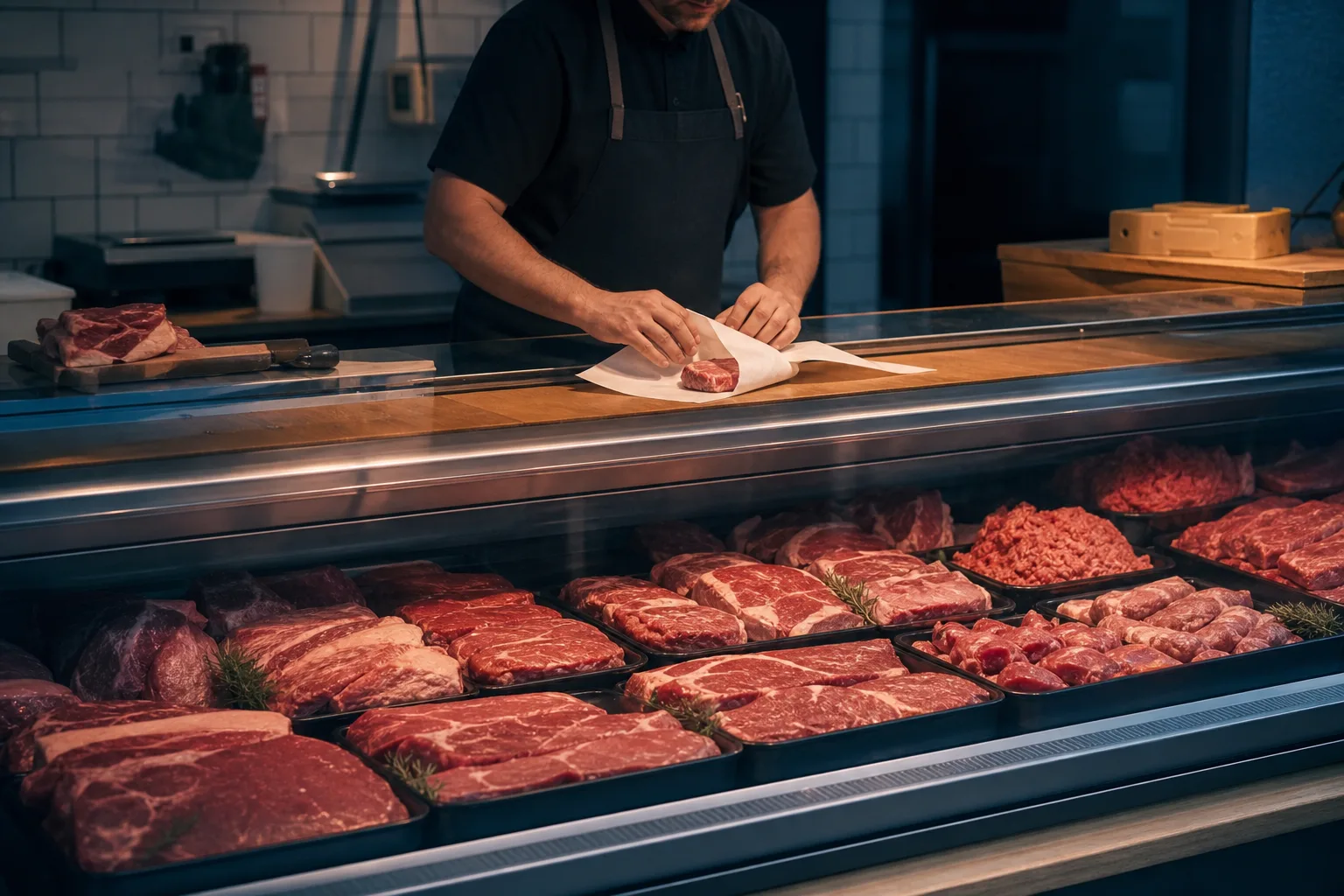
Between a store's loading dock and your refrigerator there are fewer people than you would guess, and nearly all of them will answer a direct question if you ask it plainly and at a sane hour. The butcher decides how much meat comes home in one package. The produce clerk decides which case gets culled and when the reduced cart is filled. The fish cutter decides whether your fillet leaves in a vacuum bag or a paper sheet, which sets how many days you have. None of them are selling you anything you did not already come in for, and none of them can help if you buy in silence.
One. Ask the butcher to break the package down to the meal you will actually cook
A tray of six chops is a merchandising decision, not a portion, and the case behind the glass exists so that the number can be changed. Ask for two chops, a half pound of ground beef, one chicken thigh, and watch whether the request lands as routine or as an imposition, because that reaction tells you what kind of counter you are standing at. The follow-up question matters more: ask what was cut this morning and what was cut yesterday. On color, a gray or brownish surface on vacuum-packed beef is oxidation and cosmetic. Tackiness, a slick film, a sour smell: those are the ones that count.
Two. Ask the produce clerk when the reduced cart gets filled, and what goes on it
Someone in that department walks the cases every morning with a bin, pulling anything that will not hold through the weekend, and the fate of that bin varies enormously from one store to the next. Some of it is marked down at a set hour, some goes to a food bank, some goes straight to the compactor. Ask which, and ask the time, because a bag of peppers at half price bought at nine in the morning is a Tuesday dinner and the same bag bought Friday evening is garbage you paid for. Clerks answer this question happily. It makes their bin smaller.
Three. At the fish counter, ask whether it was previously frozen, then ask for the vacuum bag
This is the single question that changes the arithmetic most, because fish that was frozen at sea and thawed for display cannot go back into your freezer with the same result, while fish that arrived fresh can be portioned and frozen the day you buy it. Ask, and ask what came in that morning rather than what is on special. Then ask them to skin it, portion it, and seal it, all of which most counters do without charge. Judging the finish here is easy: gapping, where the flakes separate into visible seams, is a real defect. A surface bruise is not.
Four. Buy cheese cut to order and tell them the size you want, not the piece they hand you
Pre-wrapped wedges are cut for the case, sized to a price point, and wrapped in plastic that suits a shelf rather than a cheese, which is why so many of them dry at the edges and sweat at the face before anyone finishes them. A cheesemonger will cut a two-ounce piece, wrap it in the waxed paper the cheese wants, and tell you how long it holds. Ask that last part out loud. On the shelf at home, the distinction worth knowing is that mold on a natural rind is part of the cheese, while fuzz on a cut face gets trimmed a half inch back.
Five. Ask what the date on the package actually means, and who put it there
The Food and Drug Administration is responsible for most food labeling in the United States, and the phrases that appear on a carton or a bag are, with the narrow exception of infant formula, not federally mandated safety deadlines. They are the manufacturer's estimate of peak quality. Store staff know this in their hands rather than in print: the dairy clerk who rotates milk every morning can tell you which items in that case fail early and which hold well past the stamp, and a deli manager can tell you which salads are made in house and which arrive sealed. Ask them, not the sticker.
What good work at a counter looks like from your side of the glass
The tell is not friendliness. It is specificity. Someone who says the salmon came in Thursday, that the strawberries will not make Sunday, that the ground lamb was run this morning and the sausage yesterday, is giving you information with a date attached to it, and that is the raw material of a week where nothing gets thrown out. Vagueness is the flaw that matters. Slowness, a brusque manner, a crowded case: cosmetic. You are asking one person to do thirty seconds of work so that you do not carry food to the trash on a Sunday night, which is a fair trade and both sides know it.
Try the five questions on one shopping trip and keep track of what came home in a smaller package than the shelf offered. That is the number that shows up later, in a refrigerator with less in it and less going out of it.