First Homeowners Policy? How the Averaging Clause Decides What a Partial Loss Pays
Under-insurance rarely shows up until a partial claim, when a proportional reduction turns a full repair estimate into a fraction of a check. Here is how to check yours before that.
Eleanor Whitcombe·5 min read·1,162 words
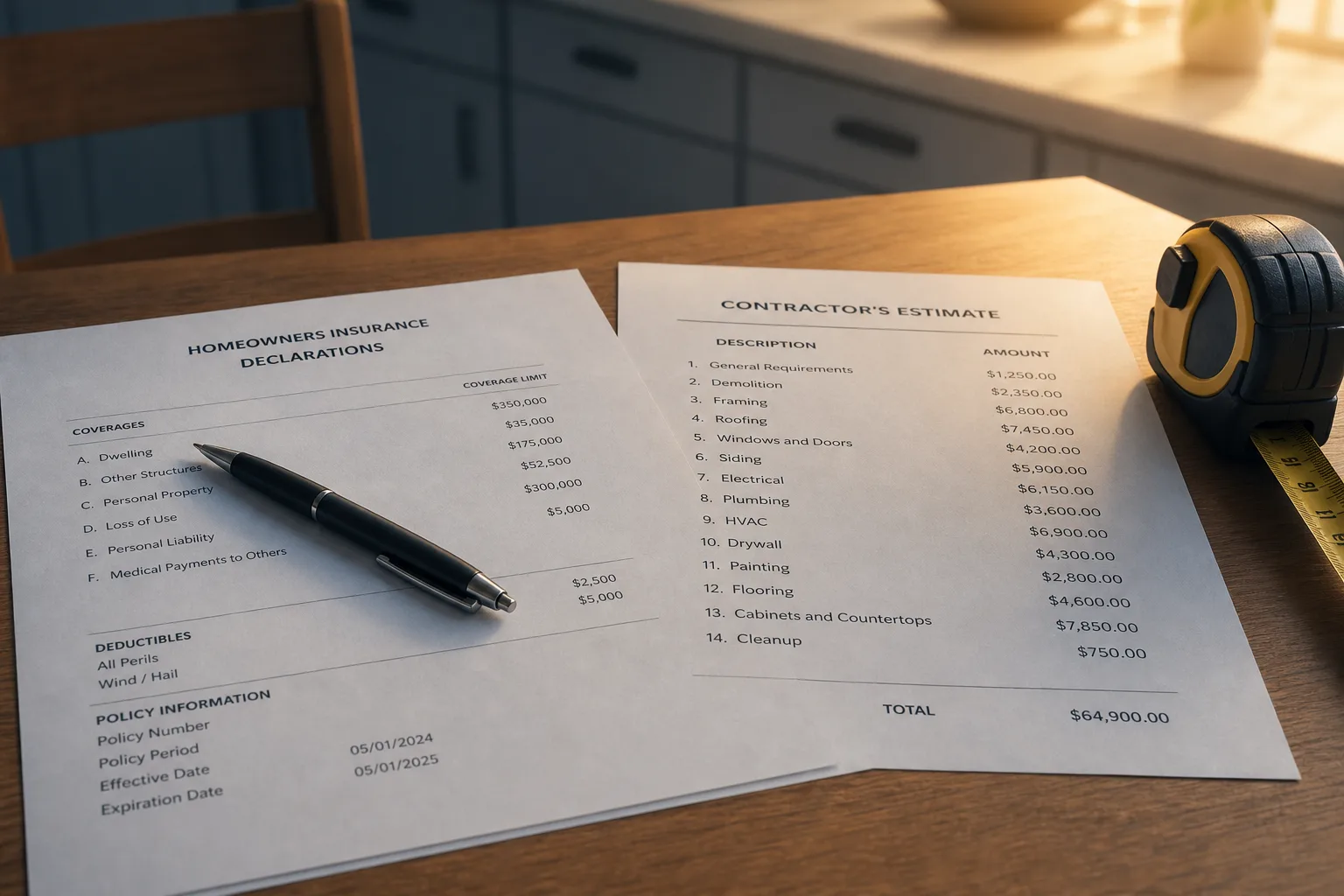
The first homeowners policy most people buy is priced, bound and filed away in about forty minutes, and the number that will matter most in a claim is chosen in roughly four of them. That number is the dwelling limit, sometimes labeled Coverage A, and it is not the price you paid for the house, not the figure on your property tax notice, and not what a broker thinks the place would sell for on a good weekend. It is an estimate of what rebuilding would cost. Get it wrong by enough and the policy quietly changes how it pays, including on losses far smaller than the limit.
The same clause, two names, two levels of visibility
In policies written in the United Kingdom, Australia, Ireland and much of the Commonwealth, the mechanism is called the condition of average, and it is named that way on the face of the contract. Homeowners there are used to hearing the word average used in a sense that has nothing to do with arithmetic means: it is an old marine insurance term for a shared, proportional loss. American forms mostly call the same idea coinsurance in commercial property, and in personal lines they bury it inside an insurance-to-value provision or a loss settlement condition. The effect is close to identical. The labeling is not, and the labeling changes how often a first-time buyer asks about it.
That difference in naming matters more than it should. A clause with a proper name gets asked about, argued over, and explained on the phone. A clause described as a loss settlement condition sounds procedural, like a rule about paperwork, and it reads as though it governs how a payment is issued rather than how much of one you get. When Canadian and British consumer guides discuss under-insurance, they tend to lead with the clause; American discussion tends to lead with the limit. The reader who understands both framings is better armed than the reader who only ever heard one.
Four different numbers describe your house, and only one is the right one
Purchase price includes land, location and the fact that two people wanted the same house in April. Tax assessment follows a local formula with its own cycle and its own appeals process, and in many jurisdictions it deliberately trails the market. A comparative market analysis answers a selling question. Reconstruction cost answers a different one entirely: what a contractor would charge, at current local labor and material rates, to rebuild this structure to today's code on a lot with a burned or collapsed house already sitting on it. Debris removal, permits, engineering, and the code upgrades that were not required when the house was built all belong in that figure.
Reconstruction can run above or below market value, and which way it runs is largely geographic. In a high land-value coastal market, the structure may be a modest fraction of the sale price. In a rural county with cheap land and thin contractor supply, rebuilding can cost well more than anyone would pay for the finished house. Buyers coming from markets where land dominates routinely under-insure after moving inland, because they carry the wrong instinct about the relationship between the two numbers. The instinct is regional. The clause is not.
What the reduction looks like on a claim that is not a total loss
Under-insurance is invisible on a total loss, in a limited sense: you collect the limit, you are short, and the shortfall is obvious and arithmetic. The trap sits in partial losses, which are the overwhelming majority of claims. Where a policy conditions full replacement cost settlement on carrying at least a stated percentage of reconstruction cost, commonly eighty percent, falling below that threshold can move settlement to actual cash value, meaning depreciated, or trigger a proportional reduction in which the insurer pays the same fraction of the repair that your limit bears to the required amount. A kitchen fire with a thirty thousand dollar estimate does not produce a thirty thousand dollar check.
Run it once with numbers and it stops being abstract. Suppose reconstruction cost is five hundred thousand and the policy requires eighty percent, so four hundred thousand. If the dwelling limit is three hundred thousand, the ratio is three quarters, and a covered partial loss can be settled at roughly three quarters of the replacement cost of the damage, before the deductible comes off. The homeowner who assumed a three hundred thousand dollar limit meant three hundred thousand dollars of protection on a small claim has misread the structure. The limit caps the payment. The ratio scales it.
The checks a first-time buyer can actually run
Ask the carrier or agent for the replacement cost estimate that produced your dwelling limit, and ask which valuation system generated it. These reports are generated from inputs someone typed: square footage, stories, foundation type, roof material, exterior wall construction, and interior finish grade. Read the inputs, not the total. A house recorded with builder-grade finishes when it has custom cabinetry and stone counters will carry a limit that was wrong from the day the policy was issued, through nobody's bad faith. Correcting an input is a phone call. Correcting it after a fire is a negotiation you will lose.
Then look for the three provisions that do the repair work on this problem. Extended replacement cost adds a cushion above the limit, often a stated percentage, which absorbs the demand surge that follows any regional catastrophe when every contractor within sixty miles is booked. Inflation guard raises the limit automatically at renewal so the estimate does not decay quietly across five years of rising material costs. Ordinance or law coverage pays for the code upgrades a building department will require on the rebuild, which older houses reliably trigger. Each is an endorsement with a price, and each is cheaper than the gap it closes.
Flood sits outside all of this and follows its own rules. The National Flood Insurance Program is administered by the Federal Emergency Management Agency, which is responsible for flood mapping and the program's coverage structure, and a standard homeowners policy does not include flood at all. First-time buyers frequently assume otherwise, because in some other countries flood is bundled into the standard household policy as a matter of course rather than sold as a separate contract. Checking which model applies to your address is a separate task from checking your dwelling limit, and it should be done the same week.
Judgment here is not about becoming an appraiser. It is about knowing that one number on the declarations page governs both the ceiling and, on most claims, the proportion, and about asking the two questions that follow: where did this figure come from, and what happens to a partial loss if it is low. Ask them at the quote stage, when the answer is free, and again each renewal when the estimate has had a year to drift.