Damp Rental, Persistent Cough. The Records That Make the First Legal Meeting Count
A family spent eight months treating a child's cough before anyone connected it to a bathroom ceiling, and the records they already had decided what their first legal meeting could do.
Joaquin Salcedo·5 min read·1,176 words
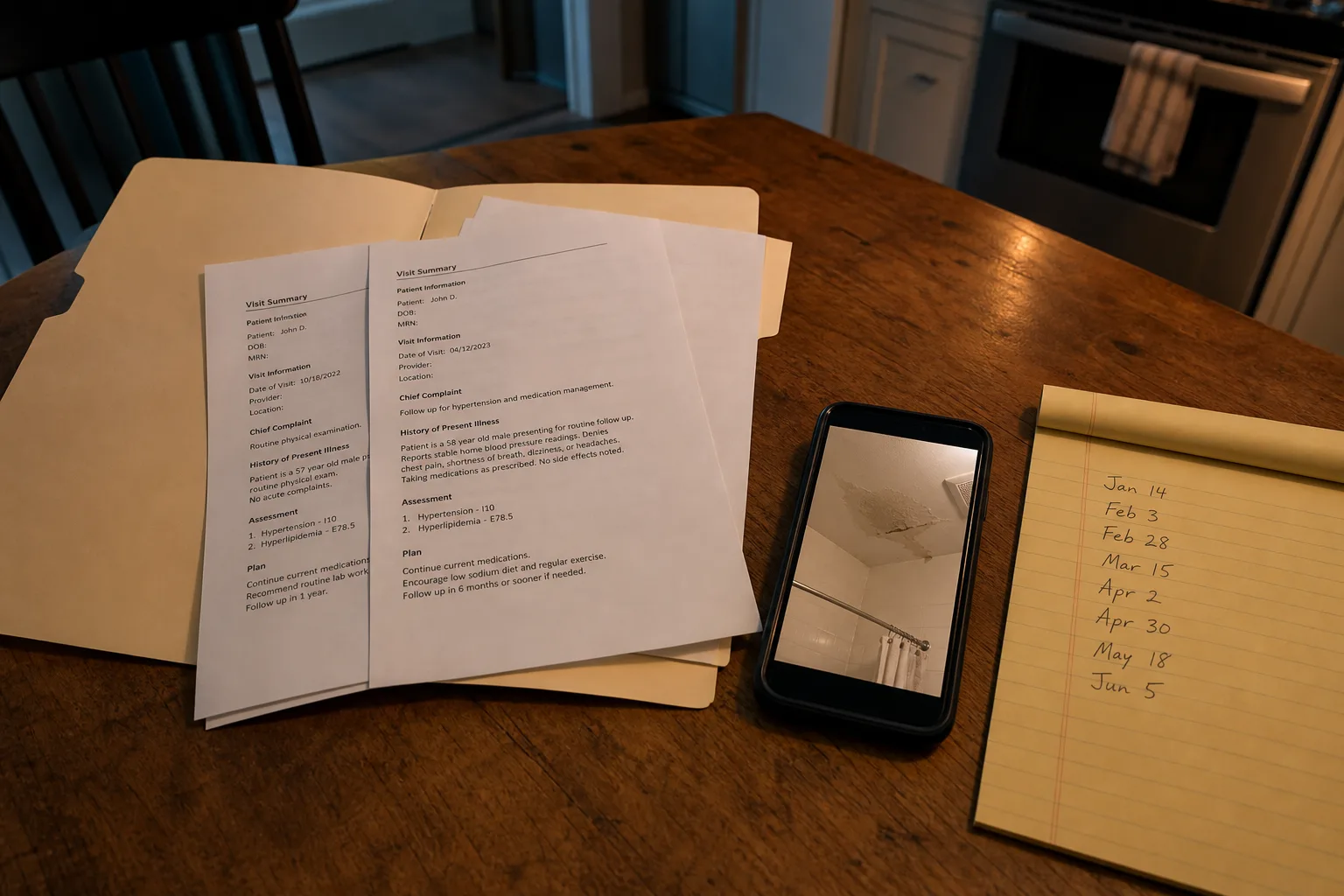
The document that mattered most in this case was a photograph nobody took for legal reasons. A parent had snapped the bathroom ceiling on a phone in late winter, because the stain had spread past the light fixture and she wanted to show her husband before he got home. That image carried a date. Eight months later, sitting across from an attorney with a folder of pediatric visit summaries and a stack of text messages to a property manager, that date was the thing that turned a complaint into a timeline, and a timeline is most of what a first meeting is for.
What follows is a composite drawn from how these consultations tend to run, not a transcript. The details are ordinary on purpose. Most households arriving at a first legal meeting about indoor conditions are not carrying a dramatic story; they are carrying a year of small inconveniences they never thought to write down, and the work of the meeting is figuring out which of those small things left a record somewhere.
The consequences nobody traced back to the ceiling
Before this family thought about legal help, they had already absorbed the cost of the problem in pieces small enough to seem unrelated. A child's cough that lingered past every course of treatment. Two missed workdays for appointments that were rescheduled. A rug, a mattress topper, and a set of towels thrown out because they smelled wrong and no amount of washing fixed it. An air purifier bought on a Saturday. Nobody sits down and totals those, because they arrive as separate small decisions across many months, and the household absorbs them the way it absorbs groceries.
That is the everyday consequence people rarely connect back to the underlying condition, and it is also, in a first meeting, the most useful thing a client can reconstruct. An attorney assessing whether a habitability or negligence claim is worth pursuing needs to know what the condition actually cost, and cost is not only rent. It is copays, replaced belongings, unpaid hours, and the utility bill in the months when a dehumidifier ran continuously. Those numbers exist in bank statements, pharmacy printouts, and card records, which is to say they are recoverable if somebody goes looking before the meeting rather than after it.
Which exposures a doctor is actually concerned about
Households tend to use the word mold for everything they see on a wall, and lawyers and doctors do not treat that word the same way. From a clinical standpoint, the questions are narrower and more practical: whether the person has an underlying respiratory condition like asthma, whether symptoms improve away from the building and return within a day or two of coming back, whether there is measurable water intrusion producing sustained damp rather than a stain from an old event, and whether anything else in the unit is contributing, such as a gas appliance venting poorly or dust disturbed by construction. The Environmental Protection Agency is the federal body responsible for indoor air quality guidance, and its framing is consistent on one point that matters to a claim: the fix is finding and stopping the water, not identifying a species.
In this case the pediatrician's notes were the strongest health record the family had, and they were strong for an unglamorous reason. Across several visits the parent had mentioned the apartment, and the clinician had written it down. That turned a set of unrelated sick visits into a documented pattern of a caregiver reporting an environmental exposure over time. No note claimed the ceiling caused anything. It did not need to. What it established was that the concern predated the lawyer, which is precisely the thing that is impossible to manufacture later.
The practical instruction that comes out of this, for anyone still in the middle of it, is to say the building out loud at the next appointment and ask that it go in the chart. Patient portals make those notes retrievable, usually as a downloadable visit summary, and a household can assemble a year of them in an evening. That is a free step, available to anyone, and it changes what the first hour with an attorney is able to do.
The record that lives on the other side
The second half of the folder was correspondence, and this is where most people are weaker than they expect. Repair requests made by phone leave nothing. Requests made in person to a maintenance worker leave nothing. This family had a mixed record: several text messages with dates, one email, and a long stretch of verbal requests that existed only in memory. The attorney's response was not to dismiss the verbal months but to look for what they touched. A work order number mentioned in a reply. A building portal that logged submissions. A neighbor who had complained about the same stack and might have written something down.
Notice is the pivot in most of these matters, meaning the moment the landlord knew, or should have known, and what happened in the interval afterward. A client who walks in able to say when the first request was made and how it was made has answered the question that otherwise consumes the appointment. A client who cannot will spend the paid hour speculating. The difference between those two meetings is not intelligence or diligence; it is whether someone spent two hours the night before scrolling back through a message thread and writing down dates in order.
What the hour actually produced
The meeting did not end with a lawsuit. It ended with three assignments, which is the realistic and useful output of a first consultation. The family was told to request their complete medical records rather than relying on the portal summaries, to send one written letter to the landlord restating the history and the current condition so that the record going forward would be unambiguous, and to stop discarding damaged items without photographing them first. They were also told what would make the matter worth formal action and what would not, which spared them months of assuming a case existed that did not yet.
From the client's side, the value was clarity about sequence. They had arrived believing the question was whether the mold had made their child sick, a question a first meeting cannot answer and an attorney will not pretend to. They left understanding that the operative questions were narrower and answerable: when notice was given, what the landlord did in response, what the condition cost the household in dollars, and whether the clinical record showed a pattern. Those are all things a family can document without expertise, and documenting them is what converts a second meeting into a decision.
The photograph of the ceiling was worth what it was worth because it existed before anyone needed it. Most of what makes a first legal meeting productive is like that: ordinary records created for ordinary reasons, gathered in order, handed across a table by someone who spent one evening putting them in sequence.