Damp, Fumes and a Doctor's Note. Five Checks That Decide Whether Your Evidence Holds Up
In a health-related property dispute, the strongest records are usually made by people you never think of as parties: the lab, the clinician, the logging device.
Joaquin Salcedo·4 min read·845 words
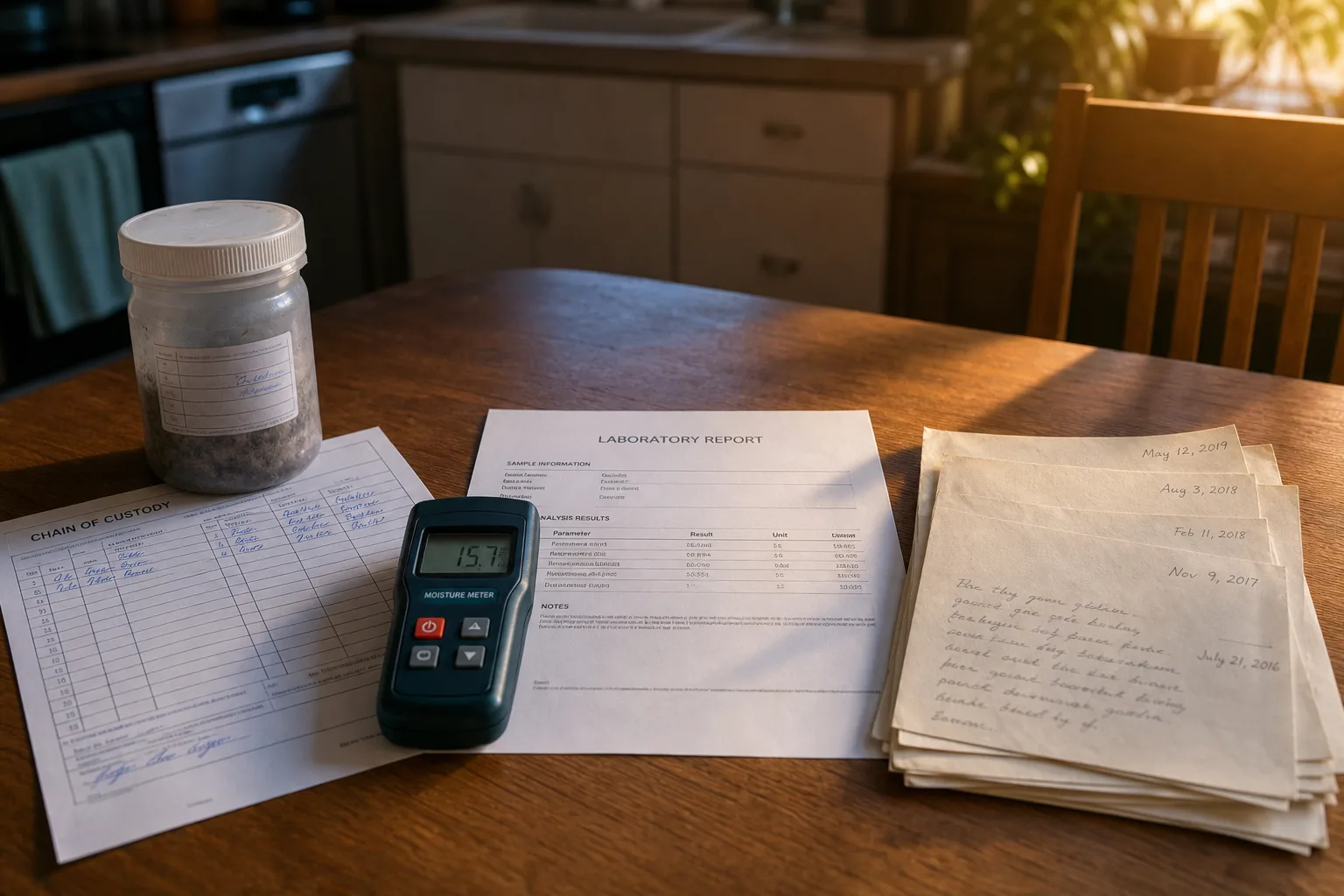
A photograph of black staining on a bathroom ceiling proves that there was staining on a bathroom ceiling, on some unspecified day, in some unspecified house. That is roughly the weight it carries when an adjuster, a landlord's attorney or a contractor's insurer looks at it six months later. Health-related complaints (damp, dust from demolition, combustion fumes, sewage backup) fail on evidence more often than they fail on merit, and they fail in predictable places. The records that survive scrutiny tend to be made by parties the household never counted as parties at all. That is the useful thing to know before you start collecting.
1. Whether the record carries its own date, or you supplied one afterward
A date you typed into a note is an assertion. A date carried inside the file, in camera metadata, in the header of a text message thread, in the timestamp on a utility or repair app, is a record. The distinction matters most in exposure complaints because the question is almost never whether a problem exists now; it is when it started, how long it ran, and who knew during that window. Photograph the same spot on the same wall repeatedly, from the same position, and keep the originals rather than screenshots, since a screenshot strips the metadata and leaves you asserting again.
2. Who ran the sample, and whether they will say so in writing
Here is the party most households overlook entirely: the independent laboratory, which never visits the property, never meets you, and reports only on what arrives in a sealed container with a chain of custody form attached. A retail mold test kit that you incubate on a kitchen counter is not that. An accredited lab report that names the analytical method, the sample identifiers, the collection date and the person who collected it is a document another professional can evaluate, argue with, and ultimately accept. The Environmental Protection Agency oversees indoor environmental hazards including mold and combustion pollutants, and its framing (identify the moisture source, fix it, then remediate) is the sequence the other side's expert will expect your evidence to follow.
Ask, before you pay anyone, whose name goes on the report and whether you receive the lab's own document or a summary written by the sampler. Those are different objects. The summary is an opinion; the lab report is data with a custody trail behind it, and the second one travels much further into a dispute than the first.
3. What a clinician will actually write down, and what they will not
Physicians are cautious about attributing symptoms to a building, and reasonably so, because coughs and headaches have many sources. What a clinic note reliably captures is dated, contemporaneous, and made by a neutral professional: the date you presented, the symptoms you described, the exposure history you gave, the treatment prescribed. Ask that the exposure be recorded in the history, plainly, without asking anyone to certify causation. The exposures that tend to prompt a clinician's real concern are the ones with known mechanisms: carbon monoxide and other combustion byproducts, sewage contamination, asbestos or crystalline silica dust released by cutting and demolition, and persistent damp in a household that includes an asthmatic, an infant, or someone immunosuppressed.
4. Whether you have numbers or only impressions
"It smelled musty" and "the air felt heavy" describe an experience that cannot be tested. A relative humidity reading of a specific value in a specific room at a specific hour, logged daily, can be. Inexpensive instruments close this gap: a pin or pinless moisture meter for wall and subfloor readings, a hygrometer that logs rather than merely displays, and a carbon monoxide alarm with a digital readout and peak memory, which preserves the high reading rather than resetting once air clears. Record instrument make and model alongside the values. A number attached to a device someone else can buy and verify is durable in a way a description never is.
5. Whether the paper trail dates the other side's knowledge
Almost every remedy in a dispute turns on notice: what the landlord, contractor, seller or manager was told, when, and what they did in the interval. Written requests establish this, and the strongest ones are boring, specific and dated, naming the room, the observation, the instrument reading, and the action requested. Keep their replies, including the ones that say nothing, and keep the invoices, work orders and technician reports they generate, since a plumber's own write-up describing a failed supply line is testimony from their side of the transaction. Send by a method that produces a delivery record, then keep the record with the letter.
Assembled in this order, the file stops being a folder of pictures and becomes a sequence: a dated onset, an independent measurement, a neutral clinical record, an instrument reading, and proof of when the other party learned about it. Most of that can be built by a household in a few weeks, at modest cost, with one lab invoice and one office visit copay as the only meaningful expenses.