A Crack in the Foundation Wall and a Denial Citing Earth Movement. What to Do Next
A stair-step crack, a denial letter, and an exclusion that names a cause rather than a kind of damage. The documents that decide which one you actually have.
Eleanor Whitcombe·5 min read·1,241 words
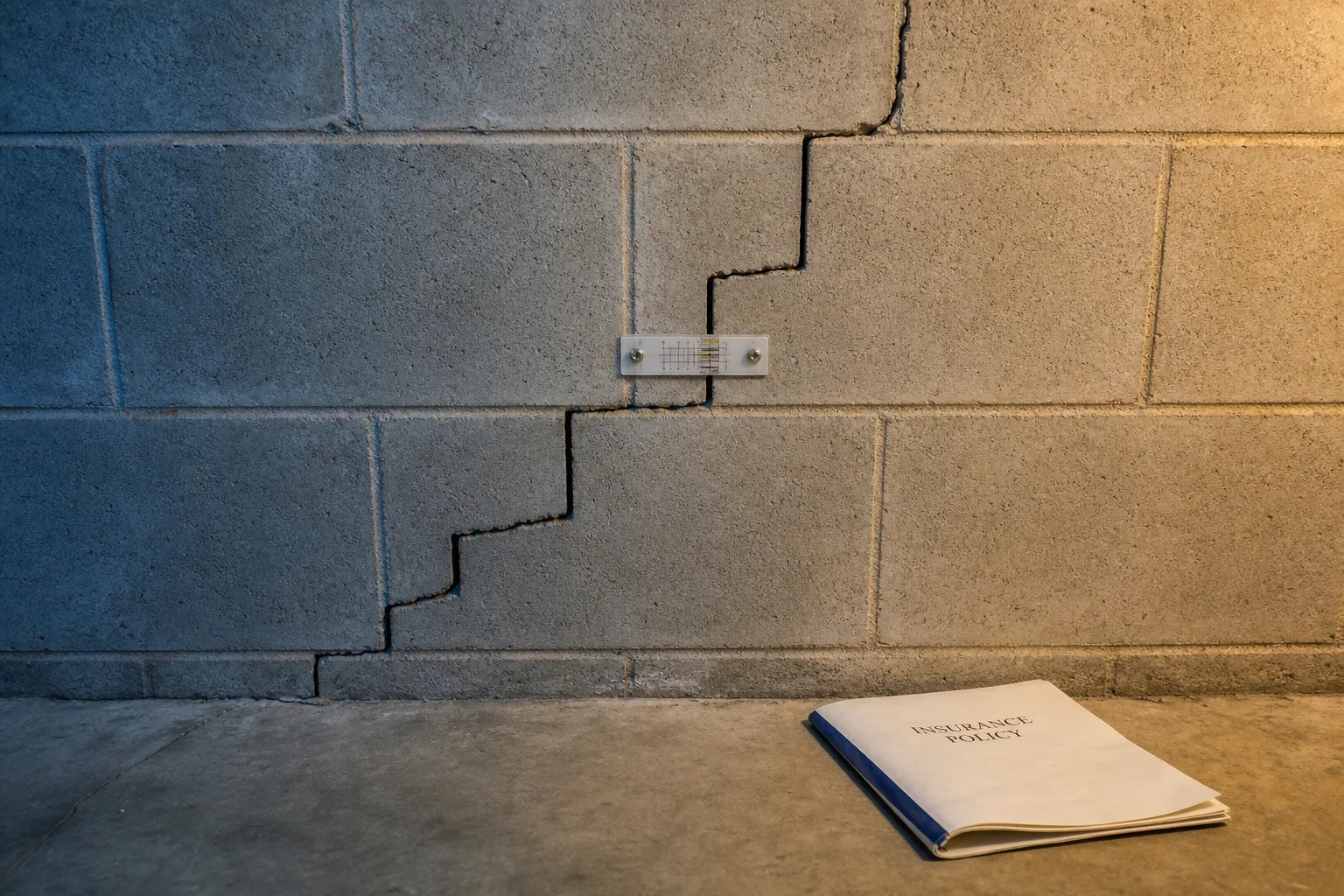
The crack runs diagonally up the block wall in the corner of the basement, stepping along the mortar joints, wide enough at the top to take a dime and closing to nothing near the floor. It appeared after a dry August. The adjuster came, took photographs, and the letter arrived eleven days later denying the claim under the earth movement exclusion, quoting a paragraph that covers earthquake, landslide, mine subsidence, sinking, rising, shifting, expanding and contracting soil. That paragraph is doing something specific, and it is not the same thing as saying foundations are not covered.
The clause names a cause, not a kind of damage
An exclusion in a homeowners policy attaches to a peril, the thing that happened, rather than to the part of the house that broke. Nothing in the earth movement paragraph says a foundation wall is outside the policy. It says that when soil moves and the movement causes loss, the carrier does not pay. So the entire dispute collapses into one factual question: what moved first. If clay soil shrank in drought and the footing dropped, the denial holds. If a supply line under the slab had been leaking for weeks, saturating and then washing out the bearing soil, the cause is water, and water is treated by a different set of paragraphs entirely.
Most policies also carry an anti-concurrent causation clause sitting just above the exclusions, and it is worth reading slowly because it changes the arithmetic. It typically says that an excluded cause defeats the claim even if a covered cause contributed, in any sequence, at the same time or in any order. That is why establishing sequence matters more than establishing contribution. A file that shows soil movement and a plumbing leak both present, with no account of which came first, is a file the carrier can close on the language alone.
What the paperwork has to establish, in order
Start with the policy itself, not the summary. Ask the carrier in writing for a certified complete copy of the form, including every endorsement listed on the declarations page, and read the declarations page against that list to confirm nothing was quietly removed at renewal. Endorsements are where policies change without anyone announcing it. Then find the ensuing loss language, which usually follows the exclusion and restores coverage for damage that flows from an excluded event when the resulting peril is itself covered. Ensuing loss provisions are narrow, they are litigated constantly, and they are the reason careful sequencing of events is worth paying for.
The second document is a leak test. A licensed plumber can run a static test on the drain line and a pressure test on the supply side, and the report should state the pressure held, the duration, and the location of any loss. The third is a structural engineer's letter, ordered by you rather than the carrier, stating a cause and a mechanism in plain terms: soil saturation from a line failure at a stated depth, or seasonal shrink-swell in expansive clay, or lateral pressure from surface water that had nowhere to go. An engineer who writes only that the wall is cracked has documented what everyone already knew.
The fourth is a dated record you build yourself. Photographs of the crack with a ruler and a newspaper in frame, a floor elevation survey showing differential settlement in inches across the span, water bills for the previous four quarters, and any earlier inspection report from the purchase. A crack gauge screwed across the fissure and read weekly for a month tells a reader whether the movement is active or finished, which changes both the repair scope and the argument about when the loss occurred.
Two countries, one crack
The American arrangement, in which ground risk is carved out of the standard policy and sold back separately or not at all, looks natural from inside and looks like a choice from outside. New Zealand attaches statutory natural hazard cover to any private fire policy automatically, so a homeowner who buys ordinary house insurance receives a defined layer of land and dwelling cover for earthquake, landslip and storm-driven land damage without asking, with the private insurer sitting above that layer. Japan sells earthquake cover as a rider to fire insurance, priced by prefecture and by construction type, with government reinsurance standing behind the largest losses. In both cases the ground is inside the system by default and the paperwork reflects it.
What that comparison exposes is an assumption rather than a defect. The United States prices ground movement as a discrete, geographically concentrated hazard, which keeps the base premium legible and pushes the decision onto the homeowner at the point of sale. It also means the useful question at renewal is not whether your policy excludes earth movement, because it almost certainly does, but which of the available add-backs your address actually justifies. That is a question with a specific answer for a specific parcel, and an agent who has the soil map and the hazard designations can give it to you in one conversation.
The endorsements that put the risk back
Several instruments exist for exactly this gap. Standalone earthquake policies are written by admitted and surplus lines carriers in most states, and in California by a public instrumentality created for the purpose, with deductibles set as a percentage of the dwelling limit rather than a flat dollar figure. Sinkhole and catastrophic ground collapse coverage is defined and regulated by statute in Florida, with testing standards attached. Mine subsidence programs operate in several coal states, sometimes as a mandatory offer. A service line endorsement, often a modest annual cost, covers the buried water and sewer pipe from the house to the street, which is the failure that starts a surprising number of foundation cases.
Flood is its own category and its own contract. The federal flood insurance program administered by FEMA covers surface water inundation that the homeowners policy does not, and it carries its own definitions of what counts, so a household in a mapped flood zone with a below-grade foundation is buying two documents that have to be read against each other. The practical step is to lay the declarations pages side by side and identify, out loud, which policy answers for water that arrives from above, from the side, and from below.
Building a file a second reader can follow
Denials are reviewed by people who did not visit the house. Send the appeal as a single indexed package: the engineer's letter first, then the plumbing test, then the photograph log with dates, then the elevation survey, then a one-page chronology written in short declarative sentences. Cite the policy provision you are relying on by its number, whether that is the ensuing loss sentence or the water damage grant, and ask the carrier to state in writing which provision it relies on in return. If the disagreement turns out to be about amount rather than cause, the appraisal clause in the policy offers a faster route than litigation, and your state department of insurance takes complaints on handling.
The crack in the corner may well be a soil crack, and if the engineer says so, the money is better spent on drainage, gutter extensions and a repair scope than on an appeal. But that determination belongs to a document, produced by someone with a license, rather than to a paragraph the adjuster quoted from memory.