Buying Whole Wheat Bread? The Front of the Bag Is the Least Useful Panel
Two loaves side by side on the same shelf, and the line that decides which one is actually whole grain sits on the back of the bag, not the front.
Hilde Brekke·5 min read·1,094 words
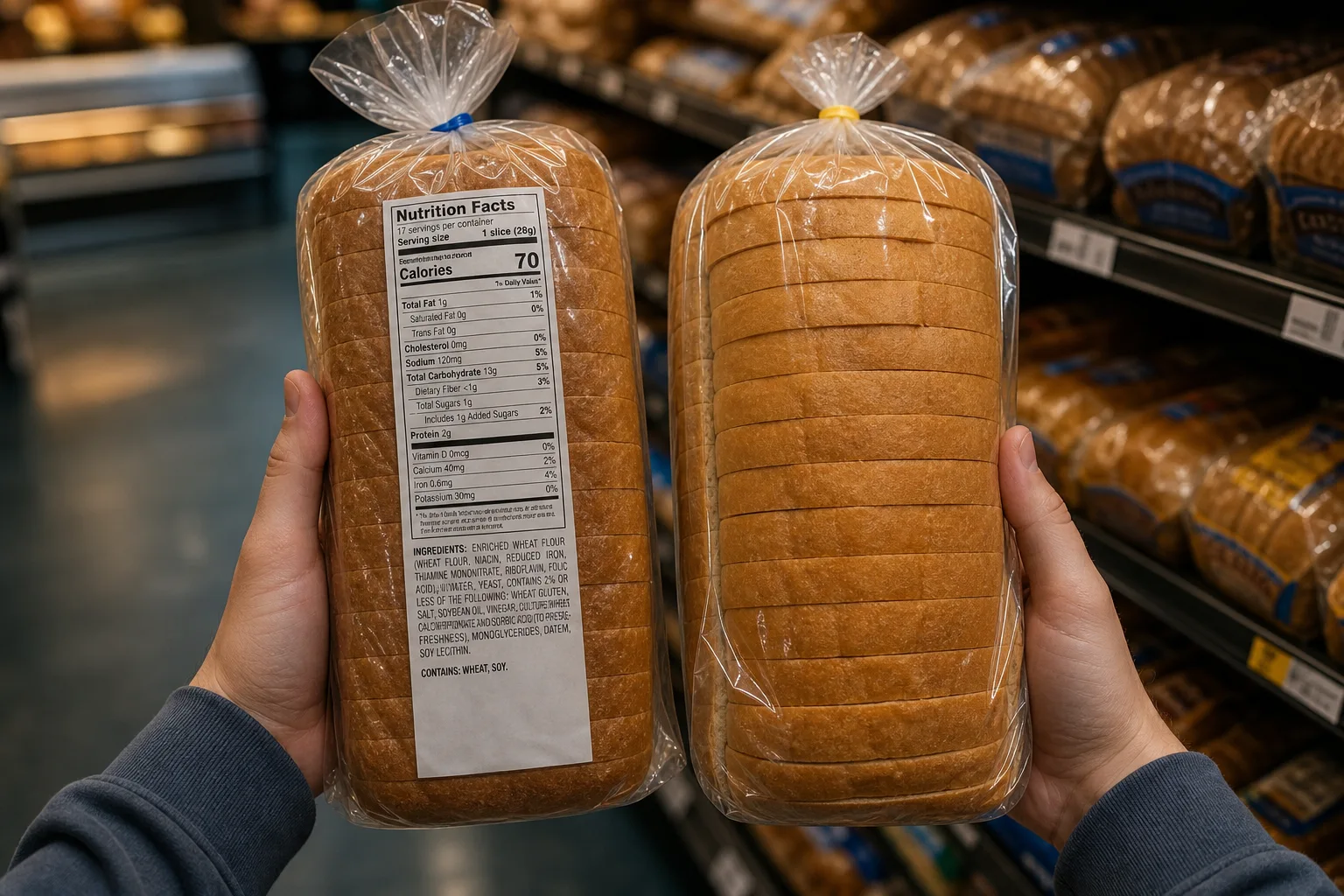
Stand in front of the bread shelf with two bags that look like they are selling the same thing. One says made with whole grain, the other says 100 percent whole wheat, and both are the same shade of brown, both have a rustic typeface, both cost within a quarter of each other. The difference between them is real and it is measurable, but it is not printed anywhere on the side of the bag facing you. It is on the back, in two places, and once you know which two, the comparison takes about fifteen seconds.
The front panel is advertising, and it is allowed to be vague
Made with whole grain is a true statement about a loaf containing a tablespoon of whole wheat flour in a dough otherwise built from refined flour. It is not a lie, and nobody is going to be penalized for it, because the claim describes presence rather than proportion. The Food and Drug Administration oversees how foods are labeled in the United States, and the rules it administers draw a sharp line between claims that carry a defined threshold and claims that simply assert that an ingredient is somewhere in the mix. Whole grain, unqualified, sits on the loose side of that line. The word percent is what tightens it, and the word first is what proves it.
So the comparison does not start with which bag looks more serious. Both bags look serious. Both were designed by people who know that brown paper, a wheat sheaf illustration, and a small-batch typeface read as virtue. Treat all of that as finish work, and remember that finish work can be applied to a poorly built loaf as easily as a good one.
The ingredient statement is the load-bearing line
Ingredients appear in descending order by weight, which means the first item is the largest single component of the loaf. On a genuinely whole grain bread, that first item reads whole wheat flour, or whole grain wheat flour, or whole grain oat flour, with the word whole doing real work at the front of the phrase. On the barely adequate version, the first item reads wheat flour, or unbleached enriched wheat flour, or enriched flour with a parenthetical list of vitamins added back. Enriched is the tell. Nothing has to be added back to a flour that never had the bran and germ removed, so the presence of restored thiamin, riboflavin, niacin, folic acid and iron is an admission about what was taken out first.
This is the check that separates a good job from a barely adequate one, and it is a single line of small type. If whole wheat flour appears fourth, after enriched flour, water and sugar, the loaf is a refined white bread wearing a costume. That does not make it inedible or dishonest. It makes it a different product than the one the front of the bag implied, and it should be priced and chosen accordingly.
Flaws that are only cosmetic
Several things on a bread label look damning and are not worth the attention they attract. Caramel color, or molasses, or raisin juice concentrate, darkens the crumb and is often read as a cover-up, but a loaf can contain molasses and still be built on whole wheat flour listed first, in which case the molasses is a flavor decision rather than a disguise. Stone ground is a milling description with no bearing on whether the germ stayed in. Multigrain means several grains, not whole ones, and a seven grain loaf can be seven refined flours. Seeds on the crust are decoration. Dough conditioners and enzymes affect shelf life and crumb structure, and they will bother some buyers on other grounds, but they are not evidence about whole grain content either way.
The distinction matters because attention spent on the wrong line is attention not spent on the right one. A shopper who rejects a loaf for containing soy lecithin while accepting one built on enriched flour has inspected the trim and ignored the frame. Judge the frame first.
The second place to look, and what it settles
The Nutrition Facts panel carries a dietary fiber figure and, since the label was redesigned, a separate added sugars line underneath total sugars. Read both, but read them against the serving size at the top, because slice weight is not standardized and a thin slice will always post a flattering number. One loaf may declare a serving as one slice at twenty-eight grams while its neighbor declares forty-three grams, and comparing fiber per slice across that gap tells you about slicing, not milling. Do the arithmetic per gram, or simply confirm that the serving weights match before you compare anything else.
Added sugars is the line that settles the argument on many sandwich breads, because a loaf sold as a health choice can carry several grams per slice, which compounds quickly across a week of lunches. A loaf with whole wheat flour first, a serving weight in the forties, meaningful fiber and added sugars at zero or one gram is a good job. A loaf with enriched flour first, a light slice, low fiber and three or four grams of added sugars is the barely adequate version, and the front of its bag will read almost identically.
What the fifteen-second check looks like in practice
Turn the bag over. Find the first word of the ingredient statement and confirm it contains whole. Move down to the panel, note the serving weight, glance at fiber and at added sugars, and put the bag back if the first check failed, because nothing further down rescues a loaf whose largest component is refined flour. Everything else, the color, the seeds, the word artisan, the illustration of a farm, is finish, and finish is the last thing to judge rather than the first. The two loaves that looked identical on the shelf have now separated, and the one worth buying announced itself in a line of type the packaging designer had no control over.
Run the same two checks on crackers, on tortillas, on breakfast cereal, and the same pattern appears: a confident front claim, a quieter back panel, and a gap between them that is entirely legal and entirely visible to anyone who turns the box around. The habit transfers. After a few weeks it stops feeling like work and starts feeling like reading the label the way it was actually written, with the claim treated as an opening argument and the ingredient line treated as the evidence.