Before the First Hard Freeze, What Your Policy's Exclusions Are Actually There to Do
Winter exclusions in a homeowners policy are routing instructions and pricing boundaries as often as refusals, and several of them were rewritten in the last few renewal cycles.
Eleanor Whitcombe·4 min read·988 words
Most policyholders read an exclusion as a refusal drafted in advance, a sentence an insurer inserted so that it would have somewhere to stand when the claim arrives. That reading is understandable, and in a minority of cases it is accurate. But the winter clauses in a standard homeowners form are doing at least three separate jobs, and only one of them is refusal. Some exclusions route a peril to a different market that is better capitalized for it. Some draw the line between a sudden accident and a slow condition. Some exist only to be bought back, for a stated premium, by an endorsement most people never ask about.
The freeze clause is a condition, not a verdict
The language that governs burst pipes in cold weather is the clearest example. A typical form does not say that freezing damage is uncovered; it says that loss caused by freezing of a plumbing, heating or air conditioning system is excluded while the dwelling is vacant, unoccupied or under construction, unless the insured used reasonable care either to maintain heat in the building or to shut off the supply and drain the system. That is a conditional exclusion, and the condition is one the household controls. It is also why adjusters ask what the thermostat was set to and whether anyone was checking the house. The clause is priced on the assumption that occupied, heated homes rarely burst, and it hands the policyholder the means of staying inside the assumption.
Ice dams sit differently. Damage from water that backs up under shingles because a ridge of ice formed at the eave is usually addressed through the roof and interior water provisions rather than a single named exclusion, and the outcome often turns on whether the ice was the proximate cause of an opening in the roof or merely the visible symptom of ventilation and insulation that were never adequate. That distinction, sudden event against ongoing condition, is the spine of nearly every property exclusion in the book. Read that way, the page stops looking arbitrary.
What the same clause looks like across a border
The habit of treating an exclusion as an abandonment is partly an artifact of how American coverage is assembled. In France, a natural catastrophe regime attaches a mandatory surcharge to essentially every property policy, and a ministerial decree declaring an event triggers coverage that individual insurers could not price alone. Spain routes extraordinary risks through the Consorcio de CompensaciĂłn de Seguros, funded by a levy collected with ordinary premiums. Norway pools natural peril losses across the whole market. Japan backs residential earthquake cover with a government reinsurance layer. In each case the private policy still excludes the peril. The exclusion is a pointer to the pool, not a statement that the loss is nobody's problem.
The United States does the same thing with less visible plumbing. Flood is excluded from the homeowners form and routed to the National Flood Insurance Program, which the Federal Emergency Management Agency oversees, or to a growing private flood market that now writes alongside it. Earthquake is excluded and sold as a separate policy or endorsement, with its own deductible structure. What the comparison shows is that an American exclusion is generally an unbundling decision rather than a moral one, and the practical question for a household is never whether the clause is fair but where the peril went and what it costs to follow it there.
What changed recently, and why it lands in winter
The last several renewal cycles have rewritten more of this page than any comparable stretch in recent memory, driven by severe convective storm losses, the cost of reinsurance, and the price of materials and labor once a roof actually has to be replaced. Three changes matter most before cold weather. Percentage deductibles for wind and hail, calculated against the dwelling limit rather than set at a flat dollar figure, have spread well beyond coastal counties. Roof payment schedules that settle older roofs at actual cash value, depreciating by age and material, now appear as endorsements on policies that once paid replacement cost without qualification. Cosmetic damage provisions exclude dents that do not compromise the roof's function.
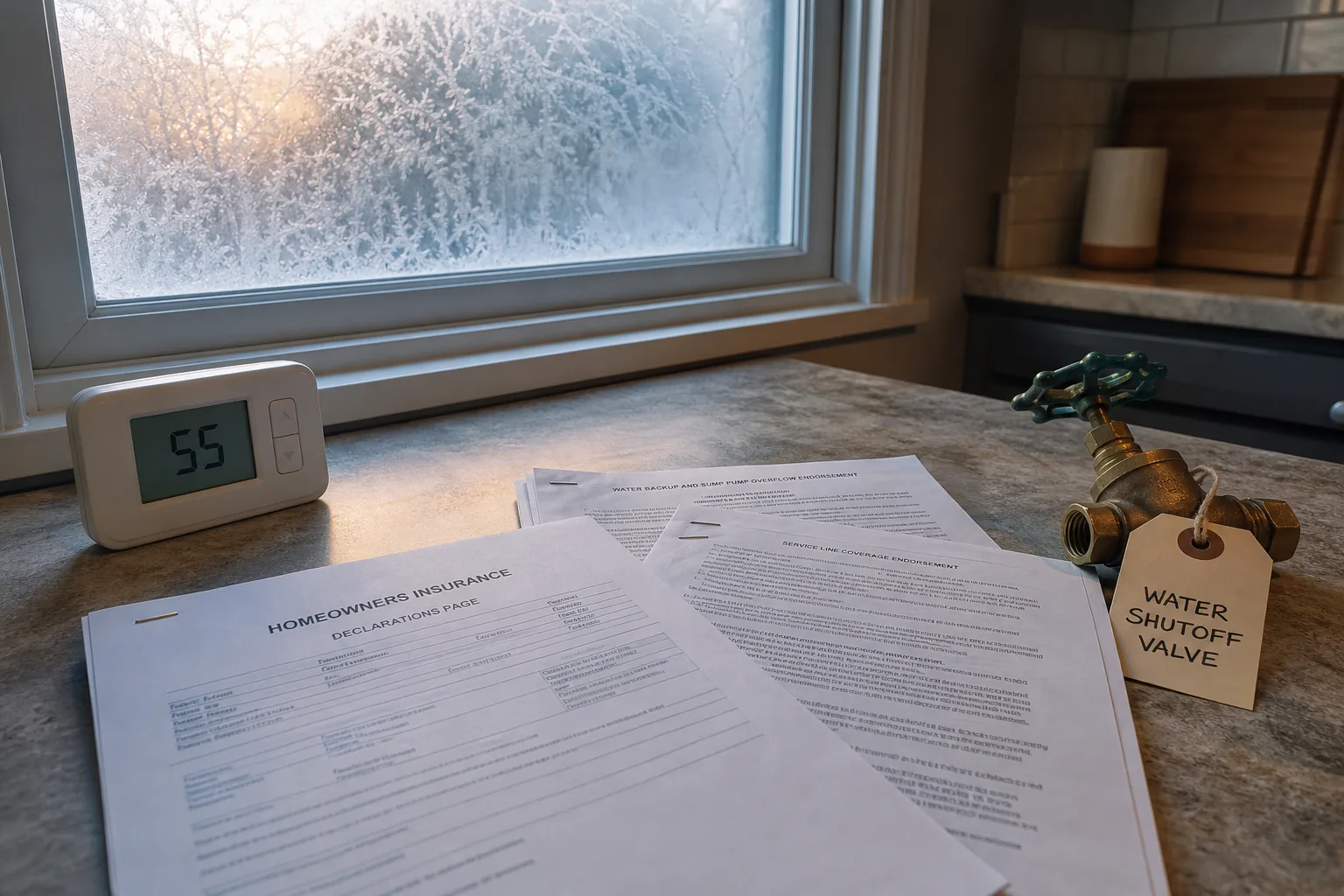
None of those is a freeze clause, but all of them decide what a February claim pays. A hailstorm in June that dented a metal roof and a snow load in January that opened a seam can produce the same water on the same ceiling and two different checks. The winter reading, then, is really a declarations page reading: the deductible line, the roof settlement endorsement if one is attached, and any water backup or service line coverage added at some earlier renewal. Insurers file these forms with state insurance departments, which is why the wording changes state by state and why a neighbor's policy may not answer your question.
The buy-back is where the leverage sits
Because most of this is unbundling, most of it can be rebundled. Water that backs up through sewers or drains, excluded in the base form, is available as an endorsement priced in the range of a modest annual add-on. Service line coverage picks up the buried water or sewer lateral that freezes or fails between the street and the house. Ordinance or law coverage funds the code upgrades a jurisdiction will require once a repair becomes a rebuild, and in older housing stock that gap is frequently larger than the deductible anyone was worried about. Replacement cost on the roof can sometimes be restored, subject to age and inspection.
Ask the agent to price each of those separately, in writing, before the renewal rather than after the loss, and ask specifically whether a roof settlement endorsement has been added since the policy was written. The clauses that look most like refusals are usually the ones with a price tag attached somewhere, and the season gives a clear deadline for finding it.